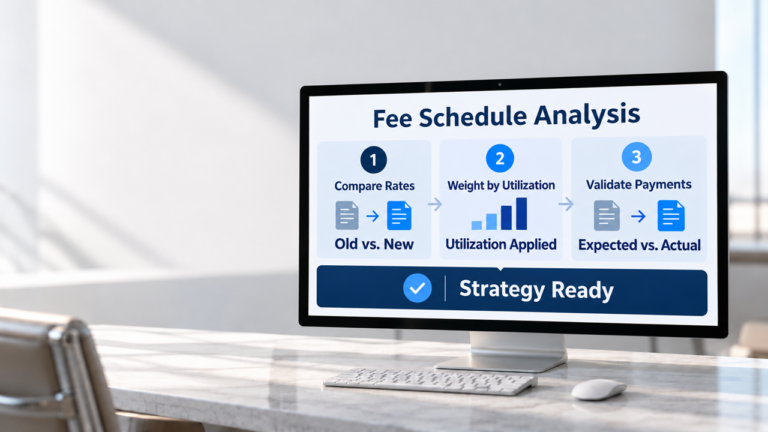
Every Fee Schedule Deserves a Home
Fee schedules need more than a storage folder. Each version should be identifiable, dated, preserved, connected to the correct payer product and contract, and available for analysis, payment validation, and future negotiation.
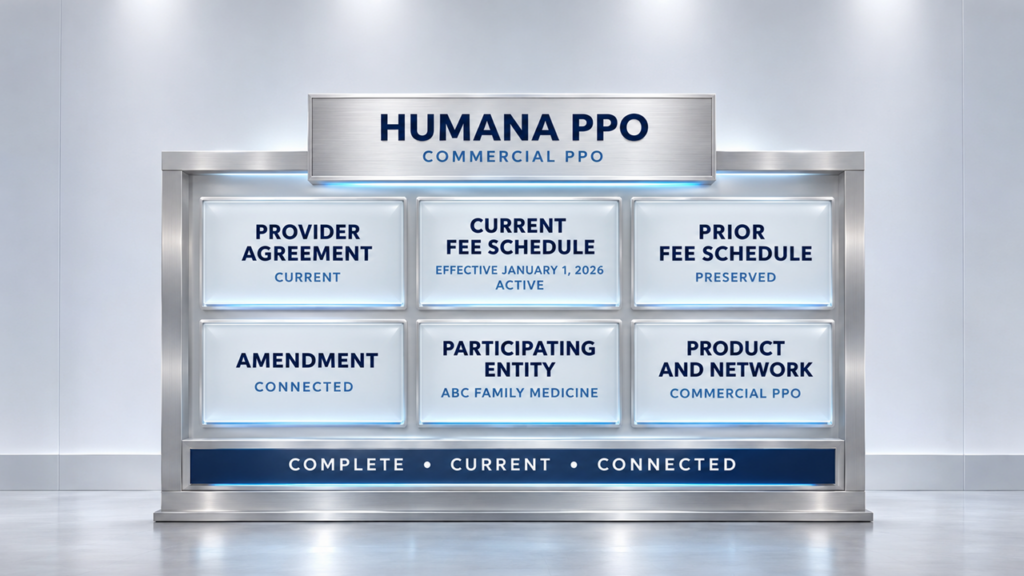
A payer contract tells a practice how the relationship is structured. The fee schedule helps determine what covered services are worth. If the practice cannot locate the correct schedule, confirm when it became effective, or connect it to the right product, meaningful reimbursement analysis begins with uncertainty.
Yet fee schedules are often scattered across email inboxes, shared drives, spreadsheets, payer portals, and paper files. Some are incomplete. Others are outdated. Several may carry similar names, with no reliable way to determine which version applies.
Every fee schedule deserves a permanent home, but storage is only the beginning. The real objective is to make each schedule identifiable, current, connected, and usable.
A Payer Contract Is More Than the Agreement
When most people think of a payer contract, they picture the signed Provider Agreement. That document matters, but it rarely tells the entire reimbursement story.
The governing relationship may also include exhibits, addenda, amendments, product attachments, notices of modification, and one or more fee schedules. A payer policy bulletin may influence claims administration, but it does not automatically become a contractual amendment. Practices need to understand what the agreement incorporates and how the payer is permitted to change reimbursement or other terms.
A Home Requires More Than a Folder
Saving a file called “Current Fee Schedule” is not enough. Current as of when? For which product? Under which agreement? For which providers, tax identification number, network, market, or location?
A well-managed fee schedule should be connected to several essential facts:
- The payer, network, and product to which it applies
- The Provider Agreement and amendment that govern it
- The participating entity, provider group, or tax identification number
- The effective date and, when known, the date it was received
- The reimbursement methodology or source used to establish the rates
- The prior version it replaced and any subsequent changes
Those connections turn a stored document into reliable contract information that another authorized person can find and understand.
One Payer May Mean Several Fee Schedules
A payer name alone does not identify the correct reimbursement arrangement. A commercial PPO, commercial HMO, Exchange plan, Medicare Advantage product, delegated network, or other line of business may use a different schedule or methodology.
Even within one product, rates may vary by specialty, geography, provider type, place of service, or contractual arrangement. A practice can possess a legitimate fee schedule and still use the wrong one for the question it is trying to answer.
The Fee Schedule May Not Be the Whole Formula
A listed allowable is important, but payment may also depend on contract language and payer rules. Reimbursement can be affected by percentage-of-Medicare provisions, lesser-of-billed-charge clauses, coding edits, bundling policies, multiple-procedure reductions, site-of-service differentials, modifiers, and other payment rules.
That means a fee schedule should not be analyzed in isolation. Practices should read it alongside the governing agreement and applicable amendments, then compare the expected reimbursement with actual adjudicated claims.
Possessing a rate and receiving that rate are two different things.
Current Does Not Mean Delete the Prior Version
Practices need the newest schedule for prospective analysis and the schedule effective on a prior date of service. Deleting older versions can complicate underpayment, recoupment, and historical contract reviews.
A better process preserves each version, records its effective period, and clearly identifies which schedule is currently active. When a payer sends a replacement, the practice should be able to determine what changed and estimate the financial effect before accepting the payer’s characterization of the update.
Before You Analyze, You Must Manage
Practices understandably want to move directly to benchmarking, payer comparisons, and negotiation strategy. But reliable analysis depends on reliable source information.
An incomplete schedule may omit important CPT® codes. An outdated schedule may understate or overstate current reimbursement. A schedule connected to the wrong product may produce a comparison that looks precise but answers the wrong question.
Strong payer strategy follows a disciplined sequence: manage the documents, analyze the financial impact, and negotiate from verified information.
Where CodeToolz Fits
This is why CodeToolz begins with management. The Payer Contract Center gives contracts, fee schedules, amendments, effective dates, and negotiation activity a connected home. The Contract Analyzer can then evaluate reimbursement using the schedule and utilization data relevant to the practice.
The goal is not simply to collect more files. It is to create a dependable record that helps physicians and practice leaders understand what they have, what it means, and what should happen next.
Your Next Step
Choose one of your three largest commercial payers. Locate the current Provider Agreement and the fee schedule you believe applies. Then ask:
- Can we identify the correct payer, network, product, and participating entity?
- Can we confirm the schedule’s effective date and the agreement or amendment that governs it?
- Have we preserved the prior version and identified what changed?
- Can we compare the listed rates with actual paid claims?
- Could another authorized person find and understand this information in less than one minute?
If the answer to any of these questions is no, the practice has identified a manageable opportunity to strengthen its reimbursement foundation.
Building Stronger Payer Strategies
At CodeToolz, we believe stronger payer strategies begin with verified information, not assumptions. We help physicians and practice leaders manage, analyze, and negotiate their payer relationships with greater clarity and control.
Because every fee schedule deserves more than a folder. It deserves a permanent, connected home where it can be found, trusted, and put to work.
Dana R. Bellefountaine Jr. | Founder & CEO | CodeToolz | The Physician’s Advocate in Payer Contracting
#CodeToolz #FeeSchedules #PayerContracts #ContractManagement #ContractAnalysis #PhysicianReimbursement #MedicalPracticeManagement #PaymentIntegrity #PayerStrategy #PhysicianPractices