The New Federal IDR Rule Sends a Clear Message: Strong Payer Strategy Matters More Than Ever
The new federal IDR framework clarifies communication, timelines, batching, and operational responsibilities. Its larger lesson is preventive: strong contract management and payment strategy should begin before an underpayment becomes a formal dispute.
Independent Dispute Resolution was created to settle certain out-of-network payment disputes when providers and payers cannot agree on reimbursement. The process protects patients from being placed in the middle, but it has also exposed how difficult and expensive payment disagreements can become for physician practices.
The Federal IDR Operations Final Rule is intended to make that process more workable. It creates clearer communication requirements, more structured timelines, revised batching rules, and new operational responsibilities for payers, providers, and certified IDR entities.
For physician practices, the larger lesson extends beyond the dispute process itself. Reimbursement strategy should not begin after a claim is underpaid and the parties are already in conflict. It should begin with a clear understanding of network participation, payment expectations, contract performance, and the financial evidence needed to support the practice’s position.
What the Final Rule Changes
The Departments released the final rule on May 28, 2026, and it was published in the Federal Register on June 4. Its provisions have varying applicability dates, with several requirements depending on supporting functionality becoming available through the federal IDR system.
The rule requires more standardized payer information, creates a formal response during the 30-business-day open-negotiation period, limits batched disputes to 50 line items, and requires eligibility determinations within five business days after certified IDR entity selection.
It also reduced the administrative fee from $115 to $15 per party and creates an IDR registry to help providers identify the responsible payer, plan, or administrator.
These changes matter because process failures can be expensive. A missed deadline, incomplete notice, ineligible claim, unpaid fee, or improperly organized batch can delay or end a dispute before the payment question is resolved.
The Provider Success Rate Needs Context
Federal reporting shows that providers, facilities, and air ambulance providers prevailed in approximately 88% of payment determinations during the first half of 2025. That rate declined to approximately 85% during the second half of the year. Health plans and issuers prevailed in approximately 14% of second-half determinations.
Those results are significant, but they do not mean every disputed payment is unreasonable or every practice should expect the same outcome. The figures include different provider types, specialties, claim values, and default decisions.
The data does demonstrate that reimbursement evidence matters. During the second half of 2025, the prevailing offer was higher than the qualifying payment amount in approximately 87% of determinations. Practices that understand market information, historical payment patterns, service complexity, and the facts surrounding the claim are better positioned to evaluate whether a dispute is worth pursuing.
IDR Is Not a Substitute for Contract Management
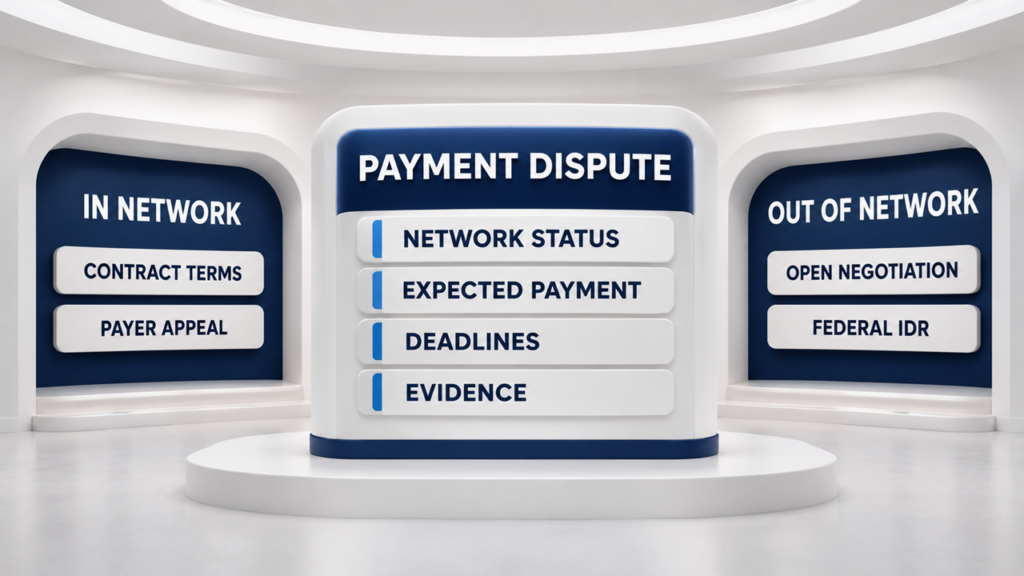
Federal IDR generally applies to qualifying out-of-network items and services. It is not a mechanism for correcting every underpayment, enforcing every contracted rate, or replacing ordinary payer appeals.
In-network reimbursement problems must usually be addressed through the provider agreement, payer policies, appeals, and contractual dispute procedures. Out-of-network disputes require a separate analysis of eligibility, applicable law, federal timelines, fees, and documentation.
A strong payer strategy recognizes both paths. The practice should know when a claim is governed by a participating provider agreement, when the payer may have violated that agreement, and when an out-of-network claim may qualify for the federal process.
Without that clarity, practices can waste time pursuing the wrong remedy, miss contractual appeal deadlines, or enter IDR without the information needed to support their position.
What the Rule Reveals About Payer Strategy
Physician practices should understand how each payer relationship performs before a dispute develops. That means maintaining current agreements and amendments, analyzing fee schedules and actual payments, identifying recurring reimbursement gaps, monitoring out-of-network exposure, and preserving the data used to evaluate payer behavior.
The same analytical discipline that supports an IDR position can strengthen ordinary payer negotiations. Market benchmarks, utilization, payment history, denial patterns, underpayments, and service-specific financial impact all help a practice move from a general complaint to a documented business case.
Strong strategy helps the practice distinguish a correct payment from an underpayment, select the appropriate response, and decide whether the likely recovery justifies the administrative cost.
Manage. Analyze. Negotiate. Before the Dispute
The Federal IDR Operations Final Rule improves the process used after open negotiation fails. Practices still gain the greatest control by preparing before they reach that point.
Manage the agreements, amendments, payer policies, deadlines, and supporting records. Analyze contracted rates, actual payments, market information, and dispute patterns. Negotiate with evidence that explains the financial issue and the change the practice is requesting.
That approach applies whether the payment problem belongs in a contractual appeal, a payer negotiation, an out-of-network discussion, or the federal IDR process. The forum may change, but the need for organized information and financial analysis does not.
Your Next Step
Review a recent out-of-network payment dispute and determine whether the practice documented the payer, plan type, network status, initial payment, qualifying payment amount, open-negotiation dates, supporting reimbursement evidence, and applicable deadlines.
Then compare that process with how the practice handles in-network underpayments. Every payment disagreement should have a clearly defined path, an accountable owner, and the documentation needed to pursue the correct remedy.
Building Stronger Payer Strategies
The new rule may make federal IDR more efficient, but process improvements do not replace payer strategy. At CodeToolz, we help practices manage payer agreements, analyze reimbursement performance, and prepare data-driven negotiations before payment problems become recurring financial losses.
The strongest position is not simply knowing how to fight a dispute. It is knowing what the practice should have been paid, why the payment is wrong, which remedy applies, and what evidence supports the next action.
Dana R. Bellefountaine Jr. | Founder & CEO | CodeToolz | The Physician’s Advocate in Payer Contracting
#CodeToolz #IndependentDisputeResolution #NoSurprisesAct #IndustryInsights #PayerStrategy #PayerContracting #PhysicianReimbursement #PaymentIntegrity #MedicalPracticeManagement