If It’s Not Defined Don’t Sign It
A contract can appear complete while leaving fee schedules, product participation, external policies, amendment rights, and reimbursement obligations unresolved. Practices should identify material uncertainty and obtain clarification before accepting contractual risk.
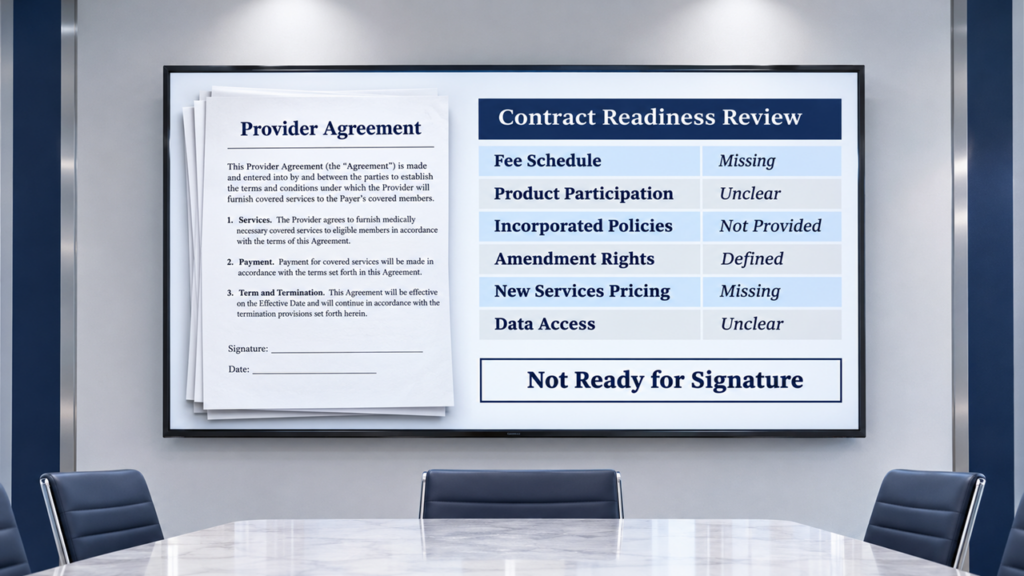
A payer agreement can appear complete while leaving its most important financial and operational terms unresolved. The contract may reference a fee schedule the practice has never received, require participation in vaguely described products, or incorporate payer policies that can change outside the signed document.
Ambiguity is not automatically evidence of bad intent. It is, however, contractual risk. If the practice cannot determine what will be paid, which rules apply, how terms may change, and what obligations it is accepting, it cannot fully evaluate the agreement.
Before signing, the goal is not to eliminate every possible dispute. It is to identify material uncertainty, request clarification, document unresolved issues, and decide whether the remaining risk is acceptable.
A Named Fee Schedule Is Not Necessarily a Defined Fee Schedule
A contract may state that reimbursement is based on the payer’s current fee schedule, a proprietary schedule, a percentage of Medicare, or another methodology. That language identifies a concept, but it may not provide enough information to calculate payment.
The practice should be able to determine:
- Which fee schedule or payment methodology applies to each product?
- Which year, locality, conversion factor, or other reference point governs the calculation?
- Are site-of-service adjustments, modifiers, multiple-procedure reductions, or lesser-of-billed-charges provisions involved?
- Can the practice obtain the complete rates needed to evaluate the agreement?
- How and when may the payer revise the methodology or fee schedule?
A schedule can be named without being available. A methodology can be described without being reproducible. Both conditions limit the practice’s ability to analyze the offer and verify future payments.
Product Participation Must Be Explicit
Some agreements apply to a single clearly identified network. Others may extend participation to commercial plans, Exchange products, Medicare Advantage, Medicaid managed care, leased networks, affiliates, or future products introduced after execution.
These products may carry different rates, authorization requirements, claim rules, dispute procedures, and administrative burdens. The practice should understand whether participation is automatic, optional, or subject to separate notice and approval.
A recognizable payer name does not establish that every product offered under that name has the same financial or operational effect.
External Policies May Become Part of the Agreement
Many contracts incorporate provider manuals, reimbursement policies, medical policies, coding policies, portal notices, and other documents by reference. Those materials may influence coverage, bundling, modifiers, documentation, claim submission, and appeals even though they are not physically attached to the contract.
The practice should identify which external documents are binding, where they are maintained, how updates are communicated, and whether the contract establishes limits on the payer’s ability to change them.
If a material payment rule can change through a website posting or general notice, the contract may be clear today but still provide limited protection against future changes.
Amendment Authority Matters as Much as the Current Language
Practices often focus on the terms in effect at signing without evaluating how those terms may be amended. A payer may reserve broad authority to change rates, policies, products, or administrative requirements after providing notice.
The practice should review the notice method, effective period, objection process, termination rights, and consequences of continued participation. It should also determine whether silence or continued claim submission may be treated as acceptance.
A defined term is more meaningful when the agreement also defines how that term can change.
New Services Need a Reimbursement Path
CPT® codes change annually, clinical capabilities evolve, and practices adopt new procedures and technologies. An agreement may not list every future service, but it should provide a process for determining coverage and reimbursement when a new code or service is introduced.
Without that process, the practice may provide a covered service without knowing whether it will be paid under a comparable code, a default methodology, an individual consideration process, or no established rate at all.
The practical question is not whether the contract predicts every future development. It is whether the contract provides a workable method for addressing developments it cannot predict.
Data Rights Must Match the Financial Arrangement
When compensation depends on quality, utilization, shared savings, risk adjustment, capitation, or other performance calculations, the practice needs enough information to understand and verify the result.
Relevant provisions may include access to attribution files, claims or encounter data, quality reports, reconciliation statements, calculation methodologies, correction procedures, and audit or dispute rights. The specific information needed will depend on the arrangement.
A financial opportunity that cannot be measured or reconciled is not fully defined from the practice’s perspective.
Questions to Resolve Before Signing
Before execution, the practice should be able to answer:
- What services, products, providers, and locations are included?
- How is reimbursement calculated, and are the underlying rates available?
- Which external manuals and policies become part of the agreement?
- What can the payer change unilaterally, and what notice or response rights apply?
- How will new codes and services be priced?
- What data is available to verify payment and performance calculations?
Not every payer will revise every requested provision. The practice can still identify the uncertainty, assess its potential effect, seek written clarification, and preserve the issue for future management or negotiation.
Your Next Step
Choose one unsigned or recently executed payer agreement and list every referenced document, fee schedule, product, policy, and payment methodology that is not physically included. Confirm that each item can be obtained, identified, and connected to the correct effective date.
If the practice cannot reconstruct how payment and participation work from the agreement and its incorporated materials, the contract is not yet fully understood.
Building Stronger Payer Strategies
At CodeToolz, we help physician practices organize payer agreements, analyze reimbursement and contract performance, and prepare focused negotiation strategies supported by the terms and data that actually govern the relationship.
What is not clearly defined today can become tomorrow’s payment, participation, or administrative problem. Know what the agreement includes, know what remains uncertain, and make the decision with both in view.
Dana R. Bellefountaine Jr. | Founder & CEO | CodeToolz | The Physician’s Advocate in Payer Contracting
#CodeToolz #PayerContracts #ContractManagement #ManagedCareContracting #FeeSchedules #PhysicianReimbursement #PayerPolicies #MedicalPracticeManagement #IndependentPhysicians