A New Fee Schedule Is Not a Reimbursement Strategy
Receiving a replacement fee schedule is only the beginning. Practices must compare old and new rates, weight changes by utilization, validate actual payments, and determine whether the overall result supports their financial strategy.

A payer sends the practice an updated fee schedule. Someone downloads it, records the effective date, saves the file, and confirms that it has been received.
That is an important administrative step. It is not a reimbursement strategy.
A fee schedule is a list of allowed amounts. Until those amounts are compared, weighted, interpreted, and connected to the governing contract, the practice does not know whether the update improves reimbursement, reduces it, or quietly shifts value away from the services physicians provide most often.
Receiving the schedule gives the practice new data. The real work begins when the practice determines what that data means.
Start With the Contract
Before analyzing individual rates, the practice should determine how the contract permits the payer to change them. The compensation and amendment provisions may answer several important questions:
- Can the payer revise the fee schedule unilaterally?
- How much advance notice is required?
- Is continued participation considered acceptance?
- May the practice object, appeal, or terminate?
- Are some services paid under a separate methodology?
- Does the agreement reference Medicare, RBRVS, a market schedule, or a proprietary payer methodology?
The name of the schedule does not always explain how it was developed. A payer’s market fee schedule may incorporate Medicare values, site-of-service differentials, vendor pricing, nationally contracted rates, or other methodologies. The contract, payer notice, and reimbursement exhibit must be read together to understand what changed and whether the change was implemented according to the agreement.
Preserve the Schedule You Have
The prior fee schedule should be preserved before the replacement is loaded or distributed. It provides the baseline needed to determine which codes increased, decreased, or remained unchanged and whether the payer altered the underlying methodology.
Each version should be stored with its effective date, the payer’s notice, related amendments, and relevant correspondence. A fee schedule without a documented effective date is incomplete contract data. Once the former version is overwritten or discarded, reconstructing the practice’s reimbursement history may be difficult.
Make a Like for Like Comparison
Before calculating rate changes, the practice should confirm that the two schedules use comparable code sets. New, revised, and deleted CPT® codes can make a mechanical comparison misleading. Replacement codes may also be subject to different descriptors, bundling rules, or reimbursement methodologies.
The comparison should therefore identify additions and deletions, map replacement codes when appropriate, and isolate codes that cannot be compared directly. Only then can the practice determine whether a rate changed or the service itself was redefined.
Compare Rates at the Code Level
An overall percentage increase can be misleading. A payer may raise dozens of low-volume codes while reducing several services that generate a substantial share of the practice’s revenue. The schedule may look improved on paper while producing little benefit or even a net loss in the practice’s actual service mix.
For every relevant CPT® or HCPCS code, the practice should identify the former allowable, new allowable, dollar change, and percentage change. It should also determine whether modifiers, multiple-procedure rules, bundling edits, place-of-service policies, or other reimbursement provisions affect the amount that will actually be paid.
The listed rate matters, but it is not the only payment variable.
Weight the Results Using Actual Utilization
A code-by-code comparison shows where rates changed. A utilization-weighted analysis shows what those changes mean financially.
Consider two services. A rarely performed procedure receives a 15% increase, while a frequently billed office visit receives a 3% decrease. The larger percentage attracts attention, but the office-visit reduction may have a much greater effect on annual revenue.
Applying the practice’s actual utilization to both schedules quantifies the projected total impact. The analysis should also identify the codes driving the change and, when useful, show the effect by physician, location, or service line. Those details reveal whether a payer’s stated aggregate improvement aligns with the practice’s real reimbursement experience.
The better questions are not simply, “Did our rates increase?” They are:
- What is the projected annual financial impact?
- Which services create most of the increase or decrease?
- How does the change affect individual physicians or service lines?
- Which rates remain below Medicare or relevant market benchmarks?
- Where is reimbursement misaligned with the practice’s costs and clinical value?
Verify What the Payer Actually Pays
The new schedule should be tested against claims after its effective date. For a representative sample of high-volume and high-value services, the practice should calculate the expected allowable amount before reviewing the remittance. That expectation should reflect the contract, fee schedule, place of service, modifiers, multiple-procedure rules, and applicable claim edits.
Comparing the expected amount with the adjudicated allowance may reveal that the payer continued using the former rate, loaded the wrong schedule, applied an incorrect place-of-service value, reduced payment through an unexpected edit, or allowed a lesser-of provision to limit payment to the billed charge. A delegated entity may also use a different methodology.
Possessing the correct fee schedule does not guarantee that the claims system is using it correctly.
Turn the Analysis Into Action
Once the financial effect is known, the practice can determine the appropriate response. That may include requesting clarification, disputing an improper implementation, challenging reductions, correcting charge amounts, pursuing underpayments, or beginning a focused renegotiation.
The strongest payer discussions do not rely on a general request for better rates. They identify the services that matter, quantify the reimbursement gap, explain the financial and clinical rationale for change, and propose a specific solution.
Where CodeToolz Fits
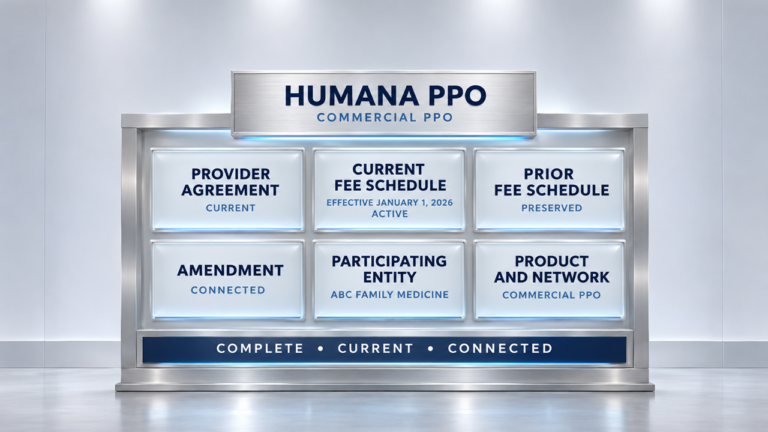
This is where the CodeToolz process brings the work together. The Payer Contract Center preserves each fee schedule, effective date, payer notice, amendment, and related contract provision. The Contract Analyzer compares code-level allowables, applies the practice’s utilization, and identifies the actual financial effect of the change.
Those findings help the practice decide whether to accept the update, request clarification, dispute an implementation problem, or pursue a negotiated improvement. The objective is not merely to possess the schedule. It is to understand what changed and determine what should happen next.
Your Next Step
Do not treat a newly downloaded fee schedule as a completed task. Preserve the prior version. Confirm the effective date. Review the contract and payer notice. Normalize the code sets. Compare the rates. Weight the results using utilization. Establish the expected allowable amounts and test them against paid claims.
A fee schedule provides the numbers. A reimbursement strategy determines how those numbers should be managed, analyzed, and negotiated.
Building Stronger Payer Strategies
At CodeToolz, we believe every new fee schedule should answer more questions than it creates. The practice should know whether reimbursement improved, which services drove the result, whether the payer followed the contract, and whether actual claims reflect the new terms.
That understanding turns a payer document into a financial decision. When contracts, fee schedules, utilization, benchmarks, and payment results are evaluated together, the practice can respond with evidence instead of assumption and strategy instead of reaction.
Dana R. Bellefountaine Jr. | Founder & CEO | CodeToolz | The Physician’s Advocate in Payer Contracting
#CodeToolz #FeeSchedules #PayerContracting #ContractAnalysis #PhysicianReimbursement #PaymentIntegrity #PracticeManagement #HealthcareFinance #RevenueCycle #ContractNegotiation