Every Dollar Counts. A Payer Negotiation Success Story.
A modest payer increase can create meaningful recurring revenue when applied across frequently performed services. This success story shows why practices must evaluate the complete offer, effective date, utilization, and financial cost of continued delay.

Not every successful payer negotiation produces a double-digit reimbursement increase. Sometimes the result is more modest, but that does not make it insignificant.
For a medical practice managing rising labor, technology, supply, and operating costs, even a measured improvement in commercial reimbursement can create meaningful recurring revenue. The value depends not only on the percentage increase, but also on the services affected, the practice’s utilization, the effective date, and how long the improved rates remain in place.
A recent negotiation involving Central Florida Ophthalmology and a major commercial payer illustrates another important lesson. Successful negotiation requires knowing when to keep pushing and when delaying an available improvement may begin costing the practice money.
When the Initial Answer Was Not Encouraging
Central Florida Ophthalmology was operating under the payer’s existing proprietary fee schedule. The objective was to obtain a more favorable reimbursement arrangement while evaluating what opportunities were realistically available within the existing payer relationship.
The payer initially placed the contract review on hold. That response could have ended the effort. Instead, we continued pursuing formal consideration of the practice’s reimbursement arrangement until the matter advanced to the payer’s analytics review process.
That progression mattered. Before the practice could evaluate a meaningful proposal, the payer first had to review the existing arrangement and determine whether a reimbursement change would be considered.
The First Offer Was Not the Final Answer
Following its review, the payer presented an initial proposal. We did not recommend accepting it without further consideration. We challenged the offer and asked the payer to reconsider the practice’s reimbursement arrangement.
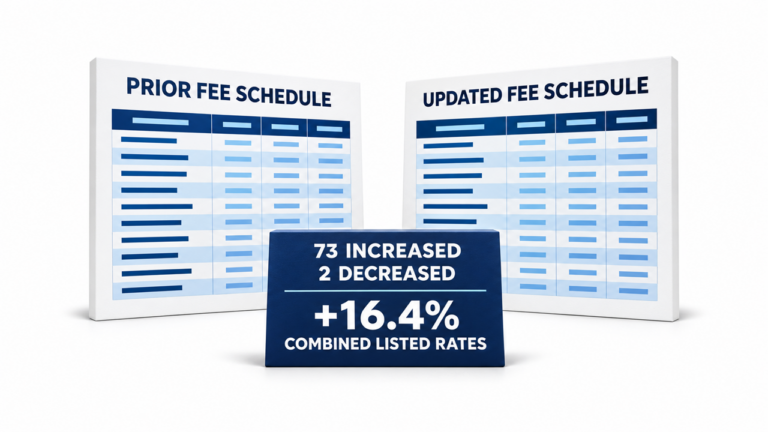
The negotiation ultimately produced an approximately 4.4% overall increase across three lines of business. The improvement applied to the payer’s proprietary reimbursement arrangement rather than being tied to a percentage of Medicare.
The percentage alone does not tell the full story. Its financial value depends on how frequently the affected services are performed and the reimbursement those services generate. When applied across meaningful utilization, a 4.4% improvement can represent revenue that would otherwise remain unrealized.
The Cost of Waiting Matters Too
After we challenged the initial proposal, the payer’s analytics review returned the same reimbursement position and characterized it as the highest level available during that review.
That did not mean the practice could never pursue another increase. It did mean we had to evaluate whether another request was likely to produce additional value now, and what the practice could lose by waiting.
Continuing the process offered no guarantee of a better result. It could, however, delay the effective date of the available increase. Every additional month under the existing rates would be another month in which the practice did not receive the improved reimbursement.
This is an important part of negotiation analysis. The decision is not simply whether a payer might eventually offer more. It is whether the probability and potential size of an additional increase justify postponing a known financial benefit.
Knowing When to Conclude the Negotiation
Persistence is essential, but persistence without financial judgment can work against the practice. A negotiation should continue when the evidence, leverage, and potential return support further action. It should conclude when the available improvement is meaningful and continued delay is more likely to defer revenue than improve the outcome.
Our recommendation was to move forward with the negotiated terms. The practice could begin benefiting from the higher rates while preserving the opportunity to revisit reimbursement in the future.
Accepting an improvement is not the same as declaring the payer relationship permanently resolved. Contract anniversaries, changes in service utilization, evolving payment methodologies, new market information, and the practice’s financial performance can all provide reasons to return to the negotiating table.
Where CodeToolz Made a Difference
Successful payer contracting requires more than asking for higher rates. It requires managing the existing agreement, analyzing the financial opportunity, developing a strategy, responding to the payer’s position, and deciding when the available result supports action.
For Central Florida Ophthalmology, our work helped move a stalled review forward, challenge the initial proposal, evaluate the resulting offer, and determine when securing the increase made better financial sense than extending the negotiation.
That is the purpose of Manage. Analyze. Negotiate. The objective is not to pursue the largest percentage for its own sake. It is to help the practice make an informed contracting decision that produces a meaningful and sustainable result.
Your Next Step
Review one recent or pending payer proposal. Look beyond the stated percentage and calculate what the offer means across the services your physicians actually perform. Consider utilization, annualized financial impact, effective date, implementation timing, and whether continued negotiation could delay an achievable benefit.
Then decide whether the evidence supports another counteroffer or whether accepting the improvement now creates greater value for the practice. The best negotiating decision is not always the one that keeps the conversation going. It is the one that produces the strongest financial outcome available under the circumstances.
Building Stronger Payer Strategies
Central Florida Ophthalmology’s experience demonstrates that negotiation success should not be measured exclusively by double-digit increases. The practice secured improved reimbursement, avoided unnecessary delay, and retained the ability to pursue future opportunities as the payer relationship evolves.
Every dollar counts. So does every well-informed decision about when to push, when to accept, and when to prepare for the next negotiation.
Dana R. Bellefountaine Jr. | Founder & CEO | CodeToolz | The Physician’s Advocate in Payer Contracting
#CodeToolz #PayerContracting #PayerNegotiations #PhysicianReimbursement #ContractAnalysis #MedicalPracticeManagement #IndependentPhysicians #HealthcareFinance