The Most Important Payer Strategy Isn’t Negotiation. It’s Taking Control of Your Contracts.
Before benchmarking rates or approaching a payer, a practice must locate its complete agreements, current fee schedules, amendments, and critical dates. Taking control of those documents creates the foundation for every stronger payer strategy.
How long would it take you to locate the complete Provider Agreements and current fee schedules for your three largest commercial payers?
Not tomorrow.
Not next week.
Today.
It is a simple question, but after years of working with physicians and medical practices across the country, we have learned that the answer often reveals the first obstacle to improving reimbursement.
The search begins. Someone checks a filing cabinet. Another searches shared drives. Someone remembers that a former office manager may have saved a copy years ago. Emails are searched. Payer portals are opened. Phone calls are made.
Before anyone can discuss reimbursement, benchmarking, or negotiation strategy, the practice is trying to locate the documents that determine how it gets paid.
That is not a criticism. It is a common reality in practices of every size.
The Foundation of Every Payer Strategy
Physicians frequently ask how to negotiate better reimbursement or identify their lowest-paying payer. Those are important questions, but they are not the first questions.
The first question is much simpler: Do you have the complete documents governing the payer relationship?
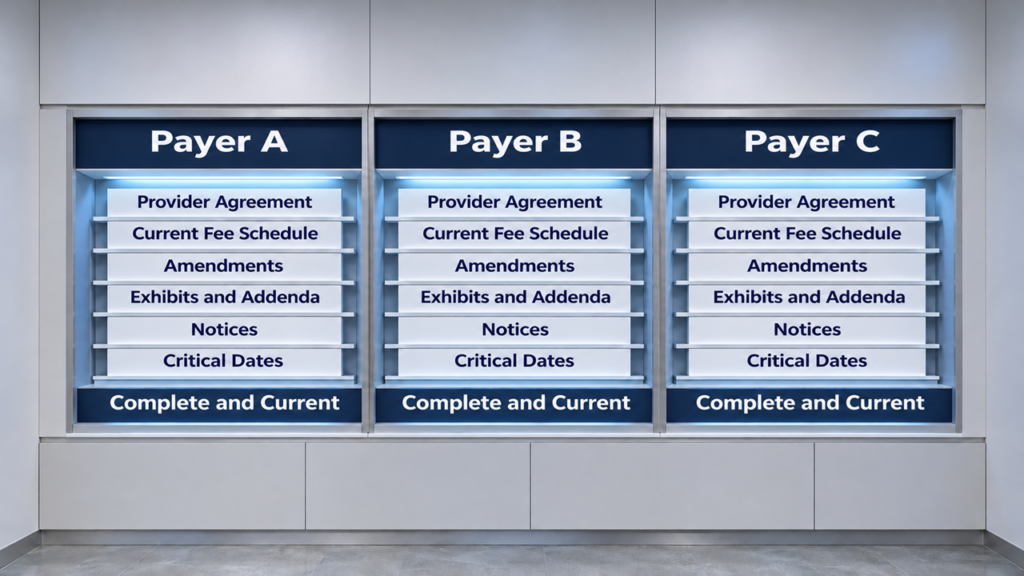
That means more than a signature page. It includes the complete Provider Agreement, every incorporated exhibit and addendum, subsequent amendments, notices of modification, and the current fee schedule that determines what each covered service is worth.
Without those documents, every discussion about reimbursement begins with assumptions instead of facts.
Taking Control Means More Than Finding a File
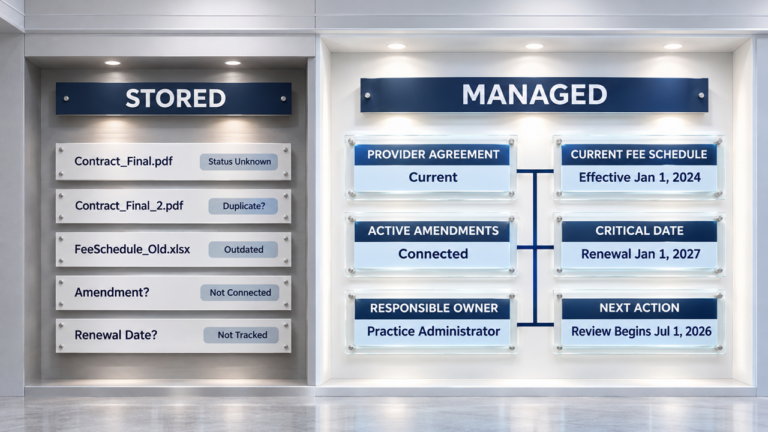
Locating a contract is an important first step, but storage alone is not contract management. A practice takes control when it can identify which documents are current, understand how they relate to one another, and retrieve the information when a reimbursement or negotiation question arises.
For each payer relationship, the practice should be able to answer:
- Which Provider Agreement currently governs participation?
- Which amendments, addenda, and notices modify that agreement?
- Which fee schedule is currently effective?
- When does the agreement renew, and what notice is required to make a change?
- How may the payer amend reimbursement or other contract terms?
- Where are the complete documents stored, and who is responsible for maintaining them?
Those answers turn a collection of documents into a managed business asset.
Imagine This in Any Other Profession
A chief financial officer would not accept being unable to locate the company’s financial statements. An attorney would not be comfortable working without the signed agreement. An architect would not proceed without the current plans.
Yet successful medical practices frequently struggle to locate the contracts and fee schedules governing millions of dollars in annual revenue.
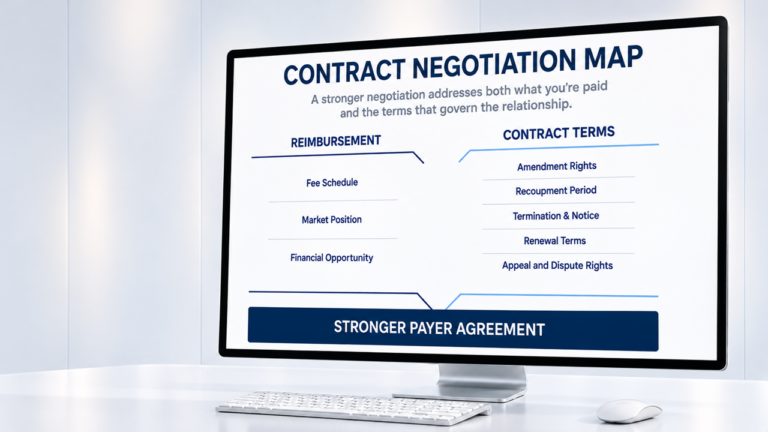
These agreements are not routine administrative paperwork. They establish payment terms, amendment procedures, audit and recoupment rights, dispute processes, timely-filing requirements, and the rules that influence financial performance. They deserve the same attention as every other critical business asset.
Start With Three Payers
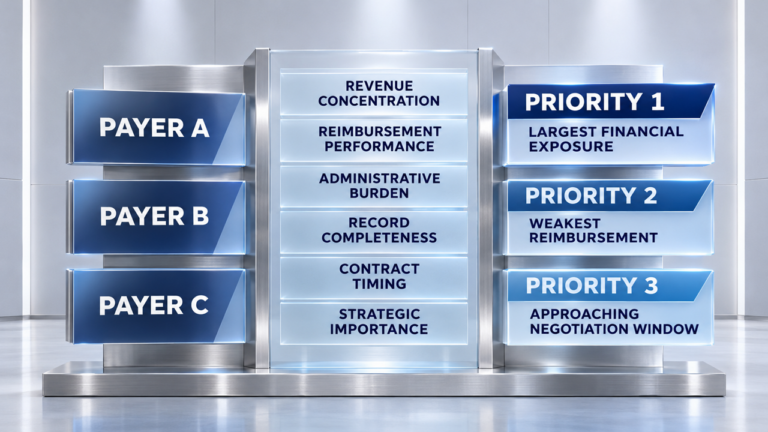
Taking control does not have to begin as a massive project. We encourage practices to start with their three largest commercial payers.
Begin with six core items: the complete Provider Agreement and current fee schedule for each payer. Then connect every amendment, addendum, exhibit, and notice that modifies those documents.
Once the information is complete and organized, important questions become easier to answer:
- Which payer reimburses the practice least effectively?
- Which contract contains outdated reimbursement language?
- Which agreement permits unilateral changes?
- Which renewal or notice deadline is approaching?
- Where are the greatest financial and contractual opportunities?
Those conversations become possible because the foundation is finally in place.
If You Do Not Have the Documents, Ask
Practices sometimes assume they must work with whatever paperwork they happen to have on file. That is not necessarily true.
A written request to the payer can ask for the complete executed Provider Agreement, all amendments and notices, and the current fee schedule. The response may require follow-up, and different departments may control the agreement and fee schedule, but the process should begin with a clear, documented request.
Rebuilding an accurate contract record is not glamorous work. It is necessary work.
Where CodeToolz Fits
This is why CodeToolz begins with management before analysis or negotiation. Through the Payer Contract Center, practices can centralize their agreements, fee schedules, amendments, effective dates, and negotiation activity. The Contract Analyzer can then evaluate reimbursement using the documents and data that actually govern the payer relationship.
The sequence matters. First, know what you have. Then understand what it means. Only then can you decide what should change and prepare to negotiate from evidence rather than assumption.
Your Next Step
This week, locate the complete Provider Agreements and current fee schedules for your three largest commercial payers. Identify any missing amendments, exhibits, addenda, or notices. Confirm which versions are current and where they will be maintained.
You do not have to negotiate them this week. You do not have to complete a financial analysis this week. Begin by establishing control.
Building Stronger Payer Strategies
Physicians cannot control Medicare reimbursement, inflation, or every policy decision made by commercial payers. They can control how well their practices understand, organize, and manage the agreements governing their revenue.
The first step toward stronger payer contracts is not asking for better reimbursement. It is taking control of the agreements you already have.
Dana R. Bellefountaine Jr. | Founder & CEO | CodeToolz | The Physician’s Advocate in Payer Contracting
#CodeToolz #PayerContracts #ContractManagement #PayerStrategy #PhysicianPractices #MedicalPracticeManagement #PayerContractCenter #ContractAnalysis #ContractNegotiation #PhysicianReimbursement