The Proven Process Behind Stronger Payer Contracts
Stronger payer contracts result from a continuous process: manage the complete agreement, analyze performance, prioritize meaningful issues, negotiate with evidence, and validate implementation. Skipping any step weakens the practice's position.

Stronger payer contracts are not created by sending a rate-increase letter and waiting for a response. They are built through a disciplined process that gives the practice control over its agreements, reimbursement data, priorities, negotiation strategy, and implementation results.
Many physician practices still approach contracting as an occasional event. An anniversary date appears, someone contacts the payer, and the practice asks for better rates. That may begin a conversation, but it does not create the information or leverage needed to manage the relationship well.
A stronger approach treats payer contracting as a continuous cycle: manage the agreement, analyze its performance, prioritize the issues, negotiate with evidence, and validate the result. Each step strengthens the next. When one is skipped, the practice negotiates with less clarity and accepts more risk.
Manage the Complete Payer Relationship
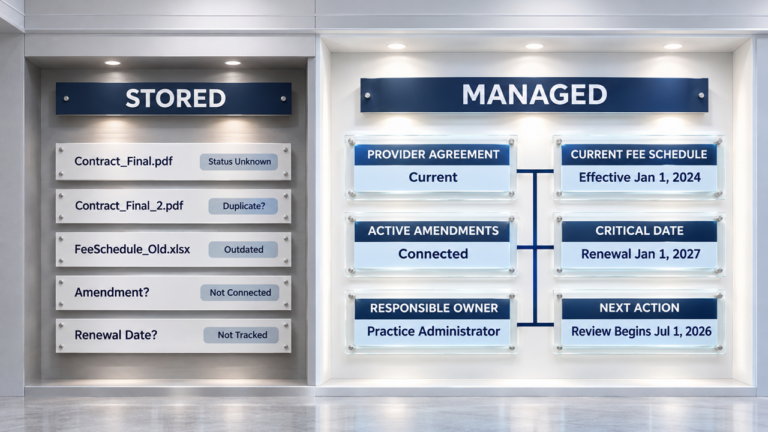
A successful payer strategy begins with knowing exactly what governs the relationship. That requires more than locating the original provider agreement.
The practice should maintain the complete contract record, including amendments, reimbursement exhibits, fee schedules, payer policies, notices, correspondence, and prior negotiation history. It should also track anniversary dates, notice periods, renewal provisions, amendment rights, termination language, timely filing requirements, appeal deadlines, and recoupment provisions.
This information should be organized so it can be retrieved and acted upon without relying on one employee’s memory or searching through disconnected folders and email chains.
Financial and operational information belongs in the same management process. The practice needs current charges, high-volume CPT® codes, utilization, payer allowable amounts, denial patterns, and actual payment experience. Together, these records answer the questions that determine whether the agreement is working:
- Do we have the complete contract and the fee schedule currently in effect?
- How does the payer calculate reimbursement?
- When were the rates last updated?
- Which terms allow the payer to change rates or policies?
- When can the practice request changes or take other action?
- Is the payer administering claims according to the agreement?
Before a practice can improve a payer agreement, it must first understand and control the agreement it already has.
Analyze What the Contract Is Producing
Organization creates visibility. Analysis turns that visibility into direction.
A meaningful reimbursement review examines the services the practice actually provides. Comparing only a few familiar codes can miss the rates that have the greatest financial effect. The practice should compare payer allowables with Medicare, other contracted payers, relevant market benchmarks, its charges, and its own utilization.
That analysis can reveal which payer is least competitive, which codes create the largest opportunity, where charges may limit payment, and where the practice is being paid below a defensible benchmark.
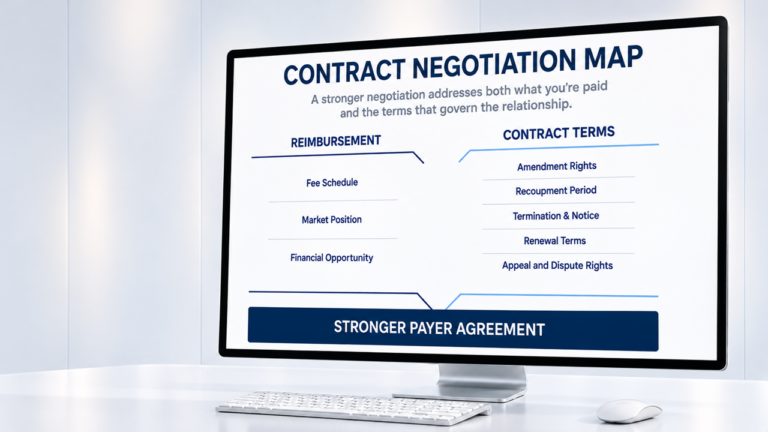
Contract language must be evaluated alongside the numbers. A payer may offer an attractive rate increase while retaining provisions that allow broad policy changes, aggressive recoupments, short filing limits, unfavorable dispute procedures, or administrative burdens that erode the value of the increase.
The real question is not simply, ‘What is the fee schedule?’ It is, ‘What financial and operational result is this agreement producing for the practice?’
Prioritize the Changes That Matter Most
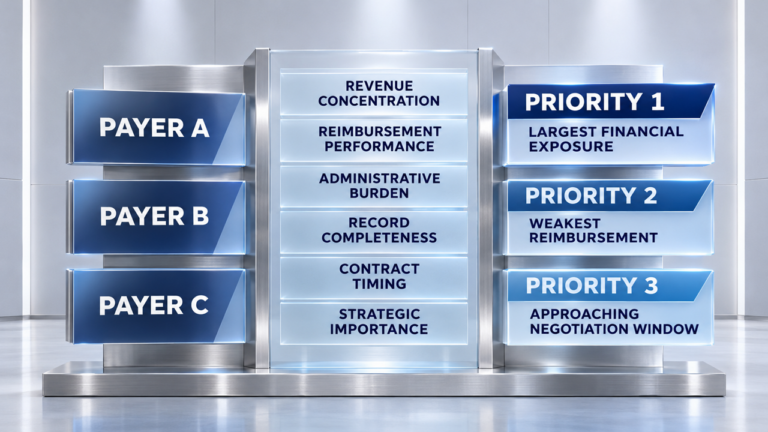
Not every low rate deserves equal attention. A substantial gap on a rarely performed service may matter less than a modest gap on a high-volume code. The same discipline applies to contract language. A provision deserves priority when it creates recurring denials, payment delays, administrative cost, or financial exposure.
A focused strategy should consider:
- High-volume and high-value services
- Rates that fall materially below Medicare, peer payers, or relevant market data
- Services with significant payer-to-payer variation
- Recurring denials, downcoding, bundling, or recoupments
- Contract terms that shift cost or risk to the practice
- Changes that support the practice’s access, growth, and service goals
Prioritization converts a general request for better reimbursement into a defined business case. The practice can explain what should change, why it matters, and what measurable result the requested change would produce.
Negotiate With Data and Practice Value
Strong negotiations combine financial evidence with the value the practice brings to the payer’s network.
The data identifies the problem. The practice’s story gives the payer a reason to solve it. That story may include patient access, appointment availability, geographic coverage, specialty expertise, continuity of care, quality results, chronic disease management, reduced avoidable utilization, or contributions to network adequacy.
The practice should enter the discussion with defined objectives, supporting comparisons, estimated financial impact, requested contract changes, and acceptable alternatives. That preparation makes it easier to evaluate a payer’s proposal instead of reacting to it in real time.
A productive negotiation does more than ask for more money. It presents a defensible request and connects that request to the services, economics, and network value of the practice.
Validate the Agreement After the Signature
A signed amendment is not the finish line. The negotiated result has value only when the payer implements it correctly.
The practice should confirm that the final language matches the discussion, the fee schedule is complete, the effective date is correct, and every revised rate has been loaded. Early claims should then be compared with the negotiated terms.
A claim can be paid and still be paid incorrectly. Missing codes, outdated allowables, incorrect effective dates, unexpected bundling, downcoding, and other payment differences can quietly erase the benefit of a successful negotiation.
Validation closes the loop. It confirms whether the agreement is performing as intended and creates the payment history needed for future contract management and negotiations.
Your Next Step
Choose one commercial payer and trace the relationship through the entire process. Confirm that the practice has the complete agreement and fee schedule. Compare reimbursement with meaningful benchmarks. Identify the rates and terms with the greatest impact. Define the practice’s network value and negotiation priorities. Then determine how the practice will verify implementation if changes are secured.
If any part of that sequence depends on memory, scattered files, or assumptions, that is the next contract-management problem to solve.
Building Stronger Payer Strategies
At CodeToolz, we help physician practices manage payer contracts and fee schedules, analyze reimbursement performance, identify the opportunities that matter most, and prepare data-driven negotiation strategies. We also help practices keep the process connected, so contract information becomes action and negotiated terms become measurable results.
Stronger payer contracts do not begin with a letter. They begin with a repeatable process that allows the practice to manage, analyze, negotiate, and validate with confidence.
Dana R. Bellefountaine Jr. | Founder & CEO | CodeToolz | The Physician’s Advocate in Payer Contracting
#CodeToolz #ContractManagement #PayerContracting #PhysicianReimbursement #FeeSchedules #ContractAnalysis #ContractNegotiation #PaymentIntegrity #MedicalPracticeManagement #PhysicianPractices