Think Your Biggest Payer Contract Risk Is Reimbursement? Think Again.
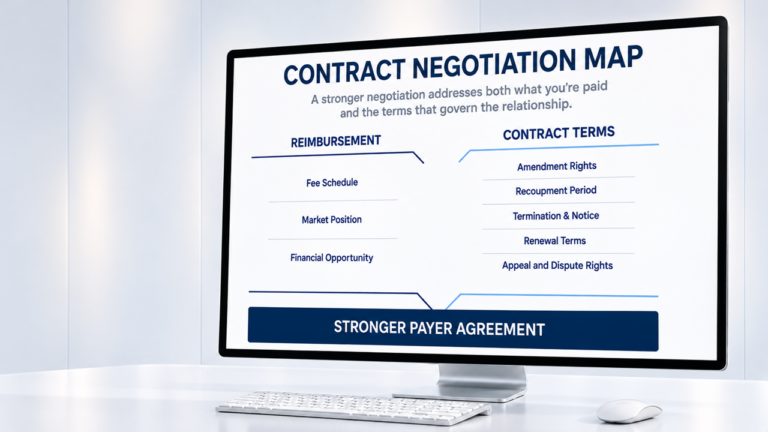
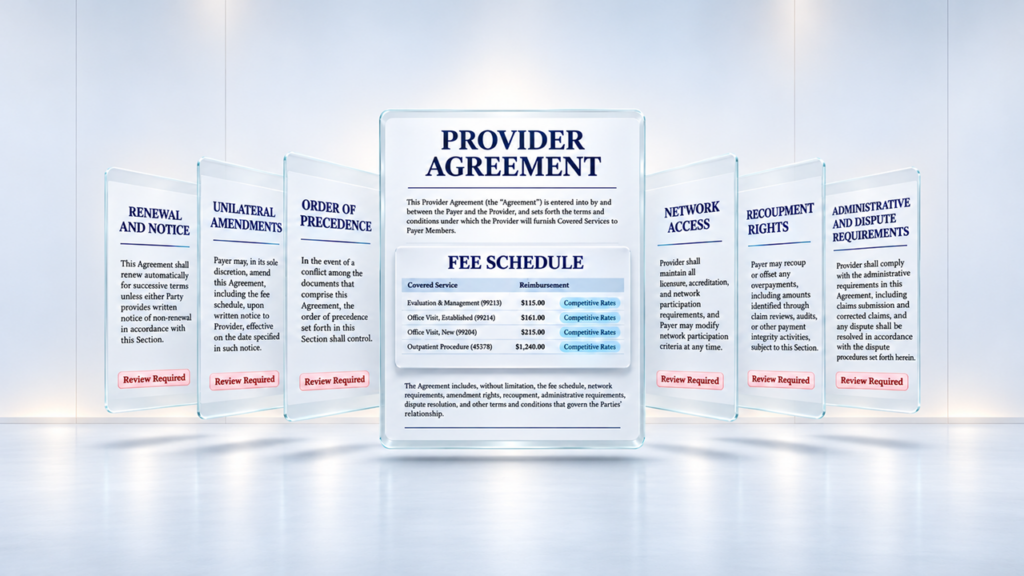
Reimbursement is only one source of payer-contract risk. Renewal terms, unilateral amendments, recoupment rights, network access, administrative obligations, and dispute provisions can reduce value even when the fee schedule appears favorable.
Ask most physicians what concerns them most about a payer contract, and reimbursement will usually lead the list. That makes sense. Rates affect revenue, staffing, technology investments, physician compensation, and the financial strength of the practice.
But a favorable fee schedule does not protect a practice from unfavorable contract language.
The agreement establishes the rules surrounding those rates. It determines how the relationship renews, how changes may be introduced, which administrative requirements apply, when payment can be recovered, and what the practice must do to preserve its rights. A practice can negotiate better reimbursement and still lose value through provisions it did not identify, track, or manage.
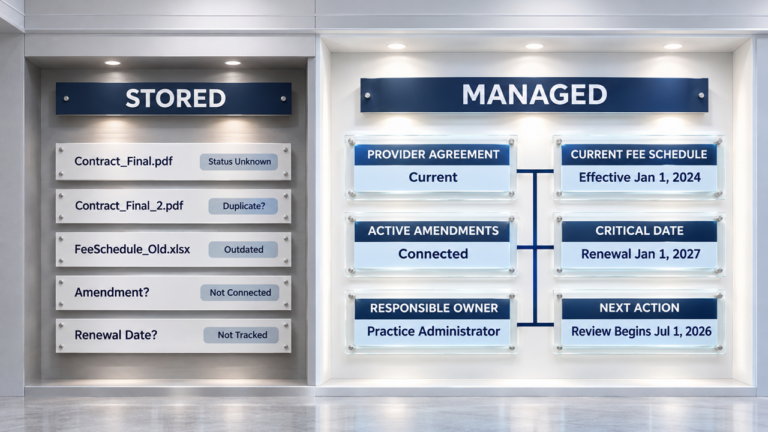
Managing payer contracts therefore begins with more than knowing what the payer pays. It begins with knowing what the agreement permits, requires, and exposes the practice to.
Every Payer Contract Governs More Than Payment
Many practices concentrate on the reimbursement exhibit and give less attention to the language surrounding it. Yet those provisions establish deadlines, allocate responsibilities, incorporate outside policies, and define how the payer may administer the relationship for years.
The greatest risk is not necessarily one especially harsh clause. It may be the interaction among the agreement, amendments, fee schedules, policy manuals, provider bulletins, and administrative procedures. The practice needs to know which documents apply and how they work together.
Automatic Renewal Can Preserve Outdated Terms
An evergreen provision allows the agreement to renew automatically unless one party provides notice within a defined period. Automatic renewal is not inherently harmful, but it can allow outdated rates and unfavorable terms to continue without deliberate review.
The deadline is only part of the requirement. The contract may also specify who must receive the notice, where it must be sent, how it must be delivered, and when it is considered received. Missing any of those details may close the negotiation or termination window for another year.
Unilateral Amendments Can Change the Relationship
Some agreements allow the payer to revise policies, manuals, payment methodologies, or administrative requirements during the contract term. Those materials may be incorporated into the agreement by reference, even though they are maintained outside the signed document.
Continued participation or failure to object within a stated period may have consequences under the agreement. Practices should preserve notices, record effective dates, identify the affected provisions, and evaluate operational and financial impact before the change becomes part of routine workflow.
Order of Precedence Determines What Controls
A contract record may include a base agreement, several amendments, product exhibits, fee schedules, policy manuals, and later correspondence. When those documents conflict, an order-of-precedence clause may determine which language controls.
Without that context, a practice may rely on an outdated provision or assume that a payer bulletin overrides negotiated language when it does not. Effective contract management connects every document to the correct payer product, effective period, and governing agreement.
Network Access Can Extend Beyond the Expected Payer
Silent PPO provisions and network-access arrangements can allow negotiated discounts to be accessed through entities or products that may not be obvious from the claim. The practical concern is not the label. It is whether the practice can identify who accessed the rate, under what authority, and whether that access is permitted by the agreement.
Unexpected discounts should be traced to the controlling contract and network relationship rather than accepted simply because the claim was paid.
Payment Can Be Revisited After the Claim Is Closed
Receiving payment does not always end the payer’s review. Agreements may address retrospective audits, overpayment recovery, offsets, documentation requests, and appeal rights. Applicable federal or state law may also affect recoupment timeframes and procedures.
Practices should understand what notice the payer must provide, how long the payer may look back, whether funds can be offset from future payments, and what deadline applies to a challenge. Otherwise, a payment recorded as final may become a financial surprise months later.
Administrative Obligations Can Defeat an Otherwise Payable Claim
Prior authorization, notification, credentialing, documentation, timely filing, reconsideration, and appeal requirements can determine whether a claim is paid and whether an adverse decision can still be challenged.
A practice may deliver medically necessary care and submit an accurate claim but still lose reimbursement because a contractual or administrative deadline was missed. These requirements belong in the practice’s operating process, not only inside a contract no one routinely consults.
Network Status Shapes Dispute Rights
The federal Independent Dispute Resolution process under the No Surprises Act generally applies to qualifying out-of-network payment disputes, not ordinary disagreements governed by an in-network fee schedule. That distinction makes contract and network status important before a dispute begins.
Practices should identify whether a service is governed by a participating-provider agreement, an out-of-network arrangement, or another applicable payment framework. Rights and remedies depend on that context.
Manage Before You Analyze
This is why the sequence matters: Manage. Analyze. Negotiate.
A practice cannot confidently analyze reimbursement until it identifies the governing agreement, current fee schedule, applicable amendments, payer product, and administrative rules. It cannot negotiate effectively if it has missed the notice window or cannot explain how contract provisions are affecting revenue and operations.
Strong analysis begins with a reliable contract record. Strong negotiation begins with understanding both the rate and the rules surrounding it.
Your Next Step
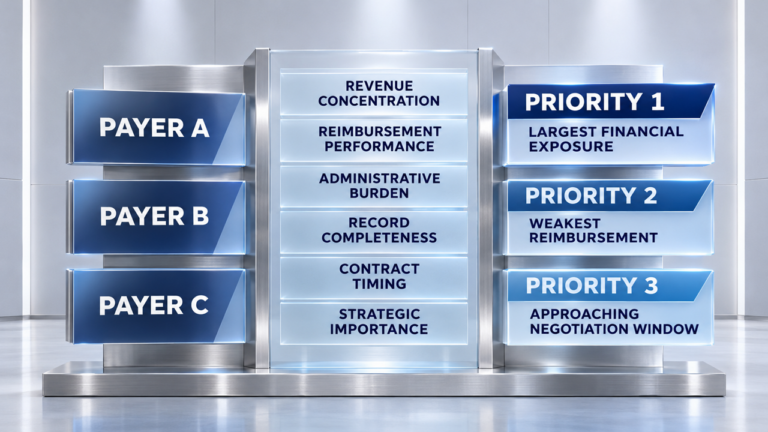
Choose one of your three largest commercial payer relationships and review something other than the reimbursement exhibit. Identify the renewal and notice requirements, amendment authority, incorporated policies, order of precedence, recoupment provisions, filing deadlines, network-access language, and dispute procedures.
Then ask whether those requirements are documented, assigned, and actively managed. A higher rate cannot protect a practice from a contract it does not understand or manage.
Building Stronger Payer Strategies
At CodeToolz, we help physicians and practice leaders organize payer agreements, identify the provisions that affect financial and operational performance, and connect that information to reimbursement analysis and negotiation strategy.
Reimbursement matters. So do the rules that determine whether the practice receives it, keeps it, and has a fair opportunity to improve it.
Know what you have. Know what it means. Know what to do next.
Dana R. Bellefountaine Jr. | Founder & CEO | CodeToolz | The Physician’s Advocate in Payer Contracting
#CodeToolz #PayerContracts #ContractManagement #ContractRisk #PayerStrategy #PhysicianPractices #RevenueCycle #PaymentIntegrity #HealthcareAdministration #IndependentPhysicians