Your Payer Contracts Are Stored. But Are They Managed?
Finding a contract in a shared drive is not contract management. Active management connects agreements, amendments, fee schedules, effective dates, responsibilities, and next actions so the practice can respond before opportunities or obligations pass.
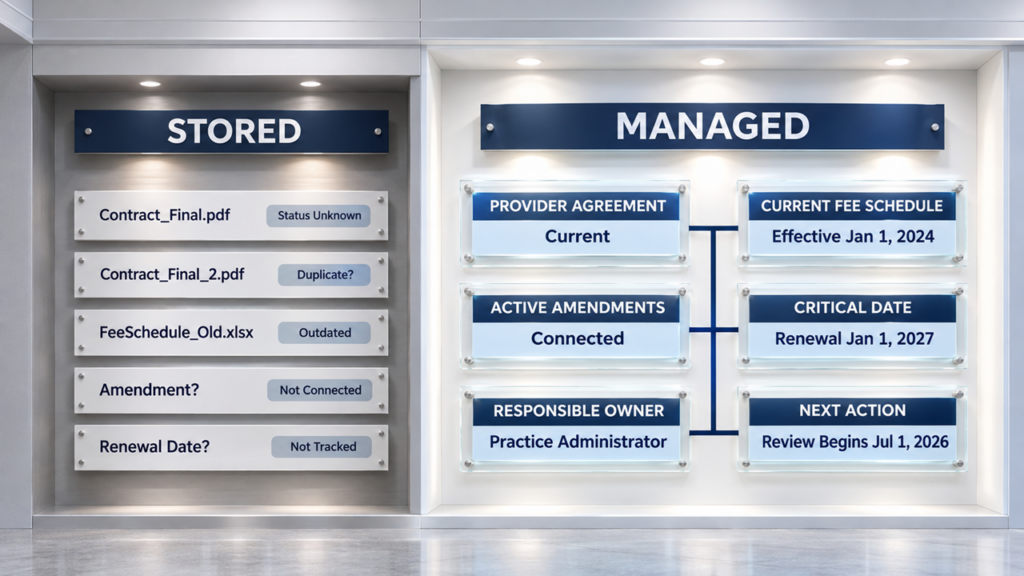
Most medical practices can locate their payer contracts eventually. The documents may be in a shared drive, an old email, or a credentialing file. The practice knows they exist somewhere.
That may mean the contracts are stored. It does not necessarily mean they are managed.
Storage answers one question: Where is the document? Active management asks whether the agreement is complete and current, which amendments remain effective, where the applicable fee schedule is, what dates require action, and who owns the next step.
A shared drive can preserve documents. It cannot connect them, interpret them, monitor them, or ensure that anyone acts on them.
Storage Is the Beginning, Not the Management Process
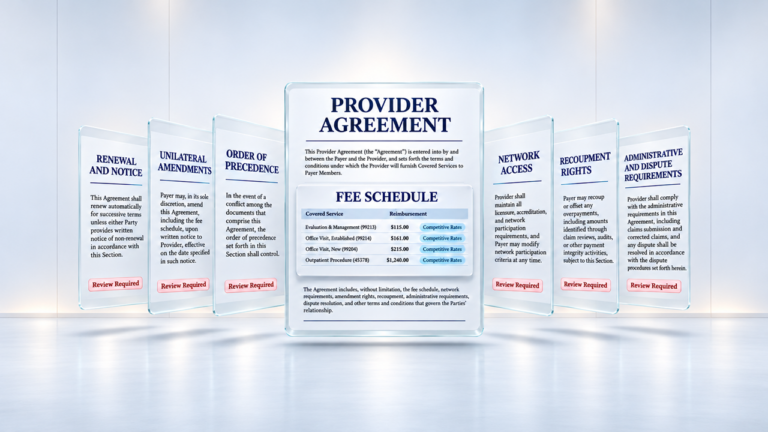
What practices call “the contract” is often a collection of interconnected documents: the provider agreement, product attachments, reimbursement exhibits, fee schedules, amendments, policy references, delegated requirements, and payer notices.
If those documents are stored separately, the practice may see only part of the relationship. An amendment may replace a reimbursement exhibit, a newer fee schedule may supersede an earlier version, and a payer notice may change an administrative requirement.
Active management creates a reliable contractual record and keeps it usable. That work involves five continuing responsibilities.
1. Assemble the Complete Contractual Record
First, identify the documents that establish the payer relationship. A complete record includes the executed agreement, active attachments and amendments, current reimbursement exhibits and fee schedules, relevant notices, and the participating providers, locations, products, and networks.
Complete and current are not the same. A practice may have the signed agreement but not the current fee schedule, several amendments without knowing what they replace, or rates without an effective date.
When something is missing, document the gap and request it from the payer. Knowing what the practice does not have is part of management.
2. Connect the Documents to the Terms They Control
The documents must be connected so the practice can determine what governs the relationship today. Each amendment should be associated with the provisions it changes. Each fee schedule should be tied to the correct contract, product, network, provider type, and effective period.
Preserve earlier versions. Historical fee schedules and amendments may be needed to validate prior payments, determine when reimbursement changed, investigate a recoupment, or establish which terms applied before a later modification.
The objective is not to accumulate files. It is to reconstruct the contractual relationship accurately for any relevant period.
3. Interpret the Governing Terms
A managed contract should show how reimbursement is calculated, which fee schedule applies, what services follow another methodology, and how the payer can modify the agreement. Renewal, termination, notice, dispute, appeal, recoupment, and timely filing provisions should also be accessible.
This creates the foundation for analysis. A practice cannot compare reimbursement accurately without the applicable fee schedule, evaluate payer performance without the payment terms, or prepare a strategy without knowing its contractual rights and limitations.
4. Monitor Dates, Changes, and Responsibilities
Contract dates should create action. Depending on the agreement, an anniversary, renewal provision, notice period, amendment effective date, or termination window may affect the practice’s options. The relevant dates and requirements vary by contract, which is why they must be extracted and monitored rather than assumed.
A managed record should identify:
- The effective, anniversary, and renewal dates that govern the agreement.
- Any automatic renewal or evergreen provision.
- The notice required to request change or exercise termination rights.
- How, where, and to whom notice must be delivered.
- The internal preparation date and the person responsible for the next action.
A date buried in a contract is passive. A date tied to an owner, advance alert, and next step becomes an operating process.
5. Act Before the Opportunity or Obligation Arrives
Preparation should not begin when a notice deadline arrives. Before approaching the payer, the practice may need to confirm the record, obtain the current fee schedule, review performance, analyze reimbursement, quantify opportunity, and establish priorities.
The same discipline applies to payer changes. Preserve, review, connect, date, and evaluate each new amendment or fee schedule before it quietly becomes part of the relationship.
This is the difference between maintaining a document archive and managing a financial asset. The managed contract informs decisions before the practice is forced to react.
Management Creates Accountability
Contract management requires ownership. Each payer relationship needs a responsible person, a visible next action, and a deadline. Without accountability, even an organized folder remains passive until a payment problem or approaching deadline creates urgency.
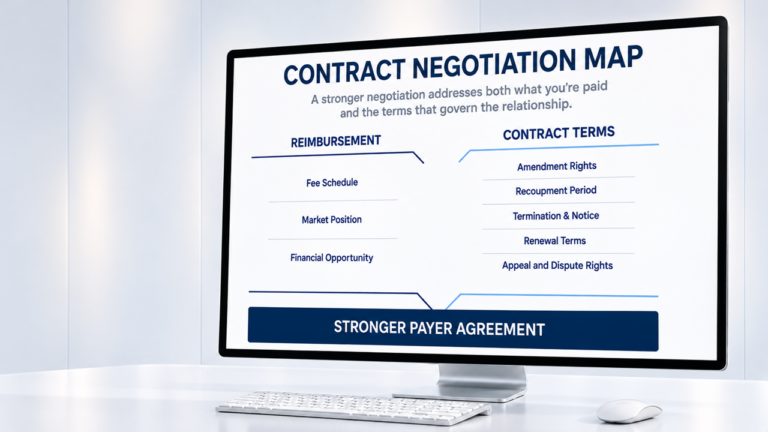
This is why CodeToolz begins with Manage. Management establishes the contractual foundation. Analysis creates financial intelligence. Negotiation uses it to pursue stronger rates, terms, and operating conditions.
Where CodeToolz Fits
The Payer Contract Center centralizes contracts, amendments, fee schedules, notices, and effective dates. Anniversary alerts turn passive dates into advance action, while status and activity records maintain continuity as the relationship changes.
The Contract Analyzer uses the correct contract and reimbursement information to evaluate code-level rates, apply CPT® utilization, identify opportunities, and assess payer proposals. That analysis is only as reliable as the managed record supporting it.
Together, the process connects the three CodeToolz pillars: manage the record, analyze what it means, and negotiate from evidence.
Start With Your Top Three
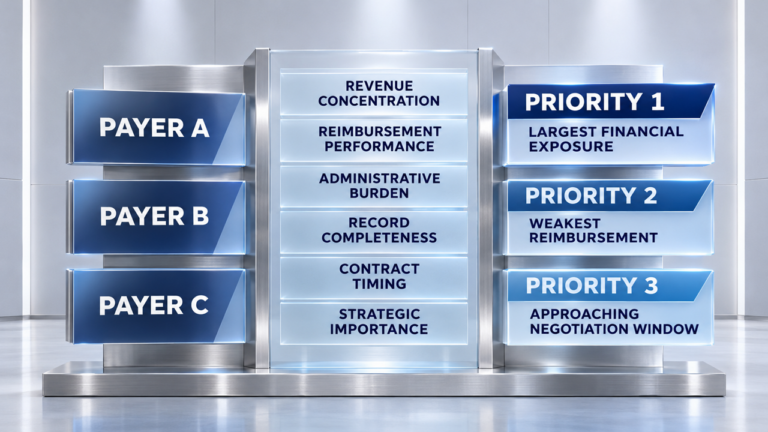
Begin with the practice’s top three commercial payers. For each, gather the executed contract, active amendments and attachments, current fee schedule, and recent reimbursement or policy notices.
Determine what is present, what is missing, which terms govern, which dates require attention, and who owns the next action. This creates a practical foundation without tackling the entire portfolio at once.
Your Next Step
Select one payer agreement. Can you identify its current fee schedule, active amendments, applicable products and networks, reimbursement methodology, next important date, and responsible owner without searching multiple locations?
If not, begin there. Do not rely on the contract for analysis or negotiation until the record is complete, current, connected, and actionable.
Building Stronger Payer Strategies
Payer contracts are financial assets, not documents to retrieve only when a reimbursement problem or deadline creates urgency.
Active management makes missing documents, critical dates, responsibilities, and financial opportunities visible. Finding the contract is not the finish line. It is where contract management begins.
Dana R. Bellefountaine Jr. | Founder & CEO | CodeToolz | The Physician’s Advocate in Payer Contracting
#CodeToolz #PayerContractManagement #ContractManagement #PayerContracts #FeeSchedules #MedicalPracticeManagement #PhysicianReimbursement #ContractAnalysis #PayerNegotiations #RevenueStrategy