Your Payer Contracts Need Attention. Which One Should Come First?
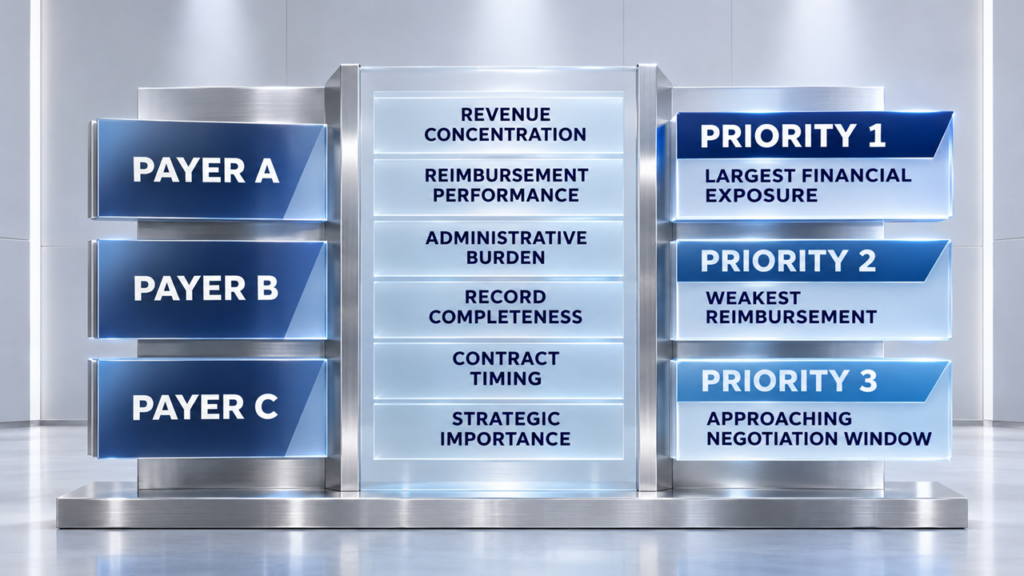
The largest or oldest payer is not automatically the first priority. Practices should rank payer relationships using financial exposure, reimbursement strength, administrative burden, record completeness, strategic importance, and available negotiation windows.
Every payer contract deserves attention, but not every contract requires the same attention at the same time. For many practices, that distinction is the difference between having a contract-management goal and having a workable contract-management plan.
The largest payer may not be the weakest payer. The oldest agreement may not create the greatest financial loss. The contract with the lowest rates may still be operationally easier than one that creates repeated denials, recoupments, or administrative work.
Choosing where to begin requires more than pulling the oldest agreement from a shared drive. It requires a structured review of financial performance, contract terms, operational burden, timing, and strategic importance.
Attention Does Not Mean Equal Priority
A practice with several commercial payer relationships can quickly become overwhelmed if it tries to review every contract, fee schedule, amendment, and policy at once. A better starting point is to identify the three payer relationships that have the greatest potential to affect revenue, workload, and future options.
That decision should not be based on instinct alone. Six factors can help determine which contract should move to the front of the line.
1. Revenue Concentration
Begin with the amount of practice revenue connected to each payer. A small reimbursement problem becomes significant when the payer represents a large share of visits, procedures, or collections. Even a modest rate improvement may create meaningful value when applied across substantial utilization.
Revenue concentration does not automatically make a payer the first negotiation target, but it establishes the size of the relationship and the financial consequence of leaving it unexamined.
2. Reimbursement Performance
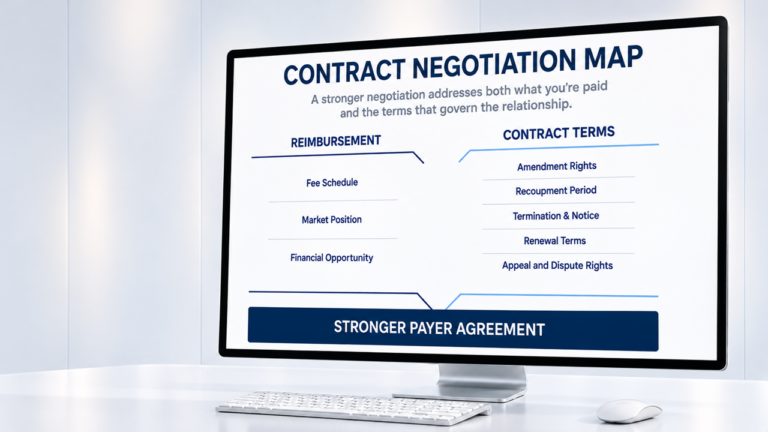
Next, determine how the payer reimburses the services the practice actually provides. A fee schedule should be evaluated at the CPT® code level and weighted using the practice’s utilization. An attractive rate on a rarely performed service does not offset weak reimbursement on the codes that drive the practice’s volume.
The analysis should also consider how rates compare with Medicare, the practice’s other commercial payers, relevant market information, and the practice’s charges. The objective is not simply to label a payer high or low. It is to quantify the financial effect of the current agreement.
3. Administrative and Payment Burden
Reimbursement rates tell only part of the story. A payer may create substantial cost through denials, underpayments, prior authorization requirements, recoupments, slow appeals, claim edits, or inconsistent application of contract terms.
Practices should consider staff time, recurring payment problems, avoidable rework, and the frequency with which the payer requires intervention. A contract that appears acceptable on paper may perform poorly after administrative cost and payment friction are considered.
4. Contract and Fee Schedule Completeness
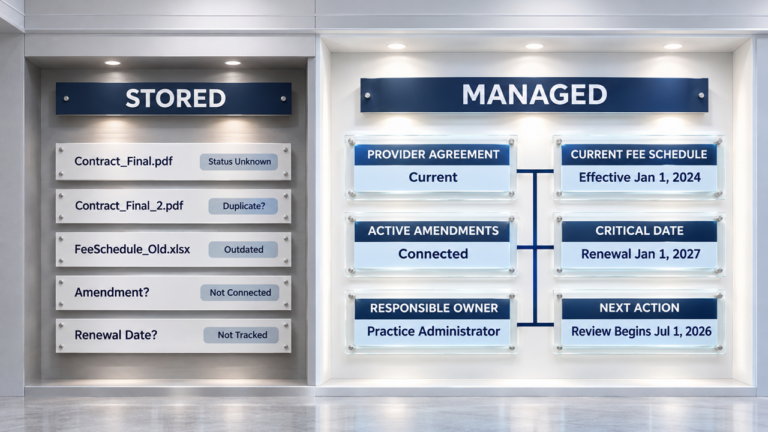
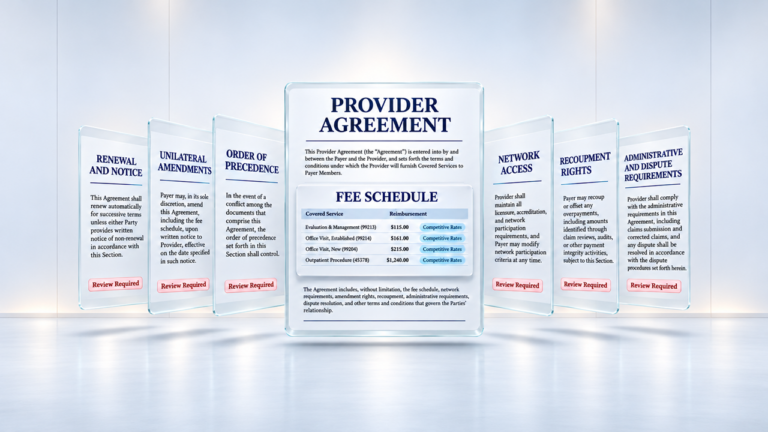
A practice cannot reliably evaluate a payer relationship without the documents that govern it. The executed agreement, active amendments, product attachments, reimbursement exhibits, and current fee schedule must be connected and reviewed together.
Missing documents are themselves a priority signal. If the practice cannot identify the current rates, amendment history, applicable products, or reimbursement methodology, it does not yet have a dependable basis for analysis or negotiation. The first action may be requesting information, not requesting an increase.
5. Contract Timing
A strong opportunity can be weakened by poor timing. Each agreement may contain its own anniversary date, renewal provision, notice requirement, amendment process, or termination window. Those provisions determine when the practice should prepare and what options may be available.
Practices should work backward from the contractual notice period. Preparation may include completing the contract record, analyzing reimbursement, reviewing payer performance, establishing priorities, and developing a supported request. Waiting until the deadline arrives turns preparation into reaction.
6. Strategic Importance
Some payer relationships matter for reasons that are not immediately visible in a rate comparison. The payer may provide access to a valuable employer population, support an important referral relationship, or represent a growing product in the market. Another payer may contribute volume that the practice cannot easily replace.
Strategic importance should not excuse poor reimbursement or performance. It should help the practice determine its objectives, acceptable outcomes, and negotiating posture.
Build a Defensible Top Three
Once these six factors are reviewed, the practice can select its top three commercial payers for focused management and analysis. One may be the largest revenue relationship. Another may have the weakest utilization-weighted reimbursement. The third may combine administrative burden with an approaching negotiation window.
The ranking does not need to be permanent. It should change as new fee schedules arrive, payer policies shift, utilization changes, or contract dates approach. The goal is to maintain a visible order of work so important relationships do not compete equally for limited time and attention.
Where CodeToolz Fits
The Payer Contract Center helps practices centralize agreements, amendments, fee schedules, effective dates, and negotiation activity. Anniversary alerts provide advance notice when a negotiation window is approaching, helping the practice prepare before an important date becomes an urgent deadline.
The Contract Analyzer then evaluates reimbursement at the CPT® code level, applies the practice’s utilization, compares payer performance, and helps quantify financial opportunity. That analysis supports an evidence-based Negotiation Package built around the practice’s actual payer relationship and priorities.
Together, the process helps the practice manage what it has, analyze what it means, and decide where negotiation effort should be directed first.
Your Next Step
List the practice’s top commercial payers and review each one against the six factors above. Do not begin by asking which payer is the most frustrating. Ask which relationship creates the greatest combination of financial exposure, operational burden, incomplete information, strategic importance, and time-sensitive opportunity.
Select the top three. Confirm that the current contract and fee schedule are available. Then assign the next action, responsible person, and target date for each relationship.
Building Stronger Payer Strategies
Payer contract management becomes more practical when the work is prioritized. The practice does not need to solve every payer relationship at once. It needs a disciplined way to determine what deserves attention now and what should come next.
When priorities are supported by contract terms, reimbursement data, utilization, operational performance, and timing, the practice can move forward with greater clarity and negotiate from evidence rather than urgency.
Dana R. Bellefountaine Jr. | Founder & CEO | CodeToolz | The Physician’s Advocate in Payer Contracting
#CodeToolz #PayerContractManagement #ContractManagement #PayerContracts #ContractAnalysis #FeeSchedules #PhysicianReimbursement #PayerNegotiations #MedicalPracticeManagement #RevenueStrategy