A Payer Contract Without a Complete Fee Schedule Is a Contract You’re Not Ready to Sign
A payer agreement cannot be evaluated responsibly without the complete reimbursement methodology. Practices should obtain the applicable fee schedule, effective date, product scope, modifiers, payment rules, and amendment terms before signing.

A payer contract establishes the terms of a business relationship. Its fee schedule establishes much of the financial reality of that relationship.
Yet physician practices are routinely presented with agreements that reference proprietary fee schedules, percentages of Medicare, or reimbursement methodologies that are not fully disclosed. The contract may be complete enough to create an obligation, but not complete enough for the practice to determine what it will actually be paid.
That is not an informed contracting decision. A practice should not sign a payer agreement until it has the reimbursement information needed to evaluate the financial commitment it is being asked to make.
A Fee Schedule Is More Than a Price List
A spreadsheet containing CPT® or HCPCS codes and reimbursement amounts is useful, but it may not represent the complete reimbursement arrangement. Rates can be changed by payment methodologies, bundling rules, modifier reductions, multiple-procedure adjustments, site-of-service differentials, and policies maintained outside the agreement.
A practice should be able to identify not only the stated rate, but also the rules that determine how that rate will be calculated, adjusted, and updated. At a minimum, the reimbursement arrangement should clarify:
- The applicable CPT® and HCPCS codes and corresponding payment amounts
- Services paid under a different methodology, such as case rates or a percentage of charges
- The Medicare Physician Fee Schedule year, locality, and geographic basis when Medicare is used
- Bundling, modifier, multiple-procedure, and other payment adjustments
- The effective date and dates of service governed by the schedule
- External reimbursement policies or manuals that can materially affect payment
- How changes will be communicated and when they may take effect
The objective is not to force every payer into the same reimbursement structure. It is to ensure that the practice can identify and evaluate the financial terms governing its services.
The Contract Language Surrounding the Schedule Matters
A fee schedule should be clearly identified, dated, and incorporated into the agreement. But incorporation alone does not protect the practice if the payer may revise reimbursement rates or payment policies at its discretion.
Practices should review the provisions governing amendments, policy changes, and notice. How much advance written notice must the payer provide? Can a revised policy apply to services performed before its effective date? Does the practice have an opportunity to review, object to, or negotiate a material reimbursement change? What happens if the practice does not agree?
These are not secondary administrative details. They determine whether the fee schedule remains a dependable contractual reference or merely a starting point the payer may alter later.
Do Not Confuse Automatic Renewal With Financial Adequacy
Evergreen provisions can allow a payer agreement to renew for successive terms without either party signing a new contract. That may simplify administration, but it can also allow reimbursement to remain unexamined for years while operating expenses, service mix, clinical capabilities, and payer policies continue to change.
A contract that renews automatically should never escape regular financial evaluation. Practices should track anniversary dates, notice periods, termination provisions, and opportunities to request updated fee schedules or begin renegotiation.
We believe every payer relationship should receive a documented reimbursement review at least annually. That review does not guarantee an increase. It creates a disciplined opportunity to determine whether the current arrangement still supports the practice.
Analyze What the Offer Means to Your Practice
Obtaining the complete fee schedule is the first step. Understanding its financial impact is the next.
Suppose a payer describes its proposal as a 6% aggregate increase. That does not necessarily mean every service increases by 6%. Some codes may receive larger adjustments, others may remain unchanged, and some may decrease. The result depends on which services the practice actually performs and how frequently it performs them.
A meaningful analysis should compare the proposed rates with the practice’s current allowables, relevant Medicare benchmarks, other contracted payer rates, historical utilization, and financial objectives. A payer’s summary percentage is not a substitute for evaluating the proposal at the CPT® code level and weighting the results by the practice’s service mix.
Before signing, the practice should be able to answer a basic question: What will this contract pay us for the services we provide? If the answer cannot be determined with reasonable confidence, the practice does not yet have enough information to make an informed financial commitment.
A Complete Fee Schedule Strengthens Negotiation
Negotiation should begin with an understanding of the existing or proposed financial relationship. A complete fee schedule allows the practice to identify which services are materially underreimbursed, distinguish inadequate rates from payment-policy problems, and develop specific requests supported by data.
This distinction matters. A higher conversion factor may still produce disappointing payment when other provisions reduce reimbursement. An increase focused on low-volume services may sound meaningful while producing little financial benefit. Effective negotiation requires the complete reimbursement arrangement, not simply a few numbers selected by the payer.
Your Next Step
Before executing or renewing a payer contract, confirm that the practice has the complete applicable fee schedule and the reimbursement policies that materially affect payment. Verify the schedule’s version and effective date, how it is incorporated, and how future changes will be communicated.
Then analyze the rates using the practice’s actual utilization. Preserve the current schedule, document the proposed replacement, and calculate the financial effect before accepting the agreement or amendment.
If the payer has not supplied enough information to understand the reimbursement arrangement, request it in writing and resolve the uncertainty before signing. A complete fee schedule should not be something the practice hopes to obtain after entering the contract. It should be part of the information required to make the decision in the first place.
Building Stronger Payer Strategies
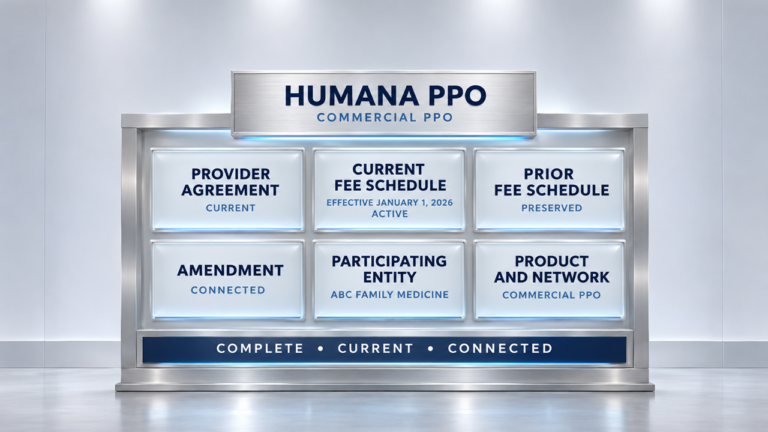
At CodeToolz, we bring the complete process together. We manage contracts, fee schedules, amendments, and critical dates in the Payer Contract Center. We analyze reimbursement at the CPT® code level through the Contract Analyzer. We then use those findings to help practices prepare focused, supportable negotiation requests.
A payer contract is more than a participation agreement. It establishes a financial relationship that can influence the practice for years. That relationship deserves transparency, accountability, and regular evaluation.
Know what you have. Know what you want. Know how to get what you want. And before you sign, make sure you know what you are agreeing to.
Dana R. Bellefountaine Jr. | Founder & CEO | CodeToolz | The Physician’s Advocate in Payer Contracting
#CodeToolz #FeeSchedules #PayerContracts #PayerContracting #PhysicianReimbursement #ContractAnalysis #ContractManagement #PayerNegotiations #MedicalPracticeManagement #IndependentPhysicians