The 2027 CPT® Codes Are Here. Is Your Practice Ready?
The 2027 CPT® changes require more than coding updates. Practices should coordinate documentation, charges, payer fee schedules, authorizations, claim edits, expected reimbursement, workflow testing, and early payment monitoring before January 1.
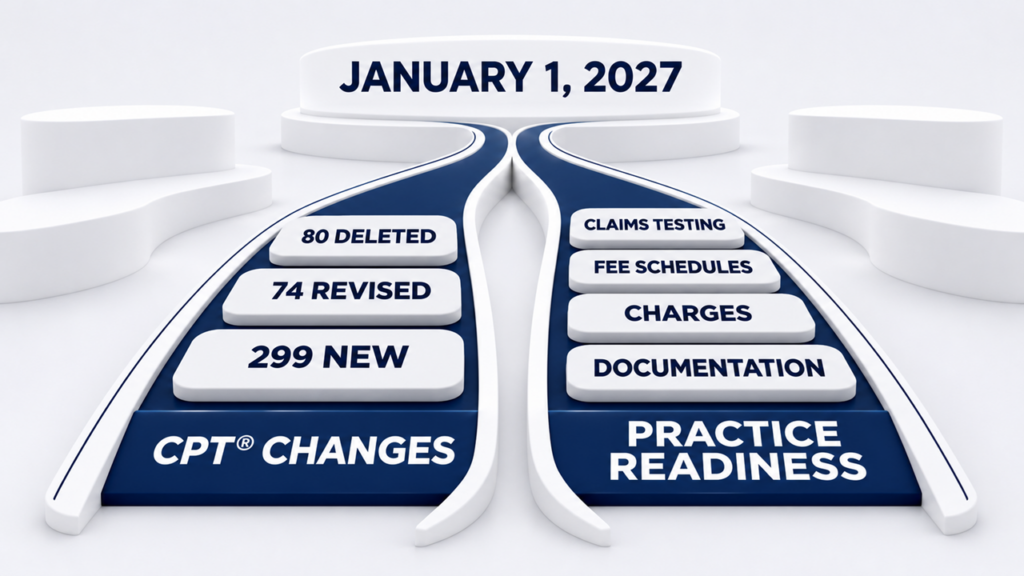
The 2027 CPT® code set includes 453 editorial changes: 299 new codes, 74 revisions, and 80 deletions. Those changes take effect January 1, 2027.
For physician practices, that should trigger more than an annual coding update. It should begin a coordinated review of documentation, charges, payer fee schedules, authorization requirements, claims edits, and expected reimbursement.
A practice can code a service correctly and still be paid incorrectly. A payer may not have loaded a new code, assigned an allowable amount, updated its claims edits, or communicated how a replacement code will be reimbursed. That is why coding readiness and reimbursement readiness are not the same thing.
The real question is not simply whether your practice has the 2027 CPT® codes. It is whether your practice is prepared to manage their financial and operational impact.
Begin With the Codes That Matter to Your Practice
Not every CPT® change will affect every specialty. Practices should begin by identifying the additions, revisions, and deletions connected to the services they actually provide. The review should prioritize:
- Frequently reported procedures and services
- High-charge or high-reimbursement services
- Codes connected to growing service lines
- Deleted codes that require replacement codes
- Revised descriptors, guidelines, or reporting instructions
- New codes that may require different documentation or authorization
- Services currently reported with unlisted codes
This turns a large annual code update into a focused practice-level assessment. The objective is not to treat every change equally. It is to identify the changes most likely to affect clinical workflows, claim acceptance, and revenue.
A CPT® Code Is Not a Fee Schedule
A CPT® code identifies and describes a medical service or procedure. It does not establish what a commercial payer will reimburse for that service.
Each payer must determine how a new or revised code will be processed under its reimbursement methodology. Depending on the agreement, a payer may assign a specific allowable, apply a percentage of Medicare, crosswalk the code to another service, bundle it, or send the claim for manual review.
A new code may also be missing from the payer fee schedule currently held by the practice. Before reporting it, the practice should ask:
- Has the payer added the code to the applicable fee schedule?
- What allowable amount has been assigned, and when does it become effective?
- Will the payer crosswalk the code to an existing service?
- Do new authorization, medical policy, or documentation requirements apply?
- How will claims be processed before the payer completes its system updates?
Without clear answers, a practice may begin reporting a valid code without knowing how the payer will recognize or reimburse it.
MANAGE the Transition
Readiness begins with organization. The 2027 CPT® dataset must be incorporated into the systems and resources the practice uses every day. That may include the practice management system, electronic health record, chargemaster, coding tools, encounter forms, authorization workflows, internal guidance, and reporting processes.
Deleted codes require particular attention. A replacement must be mapped not only in the billing system, but also to the practice’s charges, documentation templates, authorization rules, payer fee schedules, and expected reimbursement.
Practices should retain their current commercial fee schedules and reimbursement exhibits. When 2027 versions become available, the new schedules can be compared with the prior versions instead of being accepted without analysis. This creates a record of what changed, when it changed, and which payer methodology applies.
ANALYZE the Financial Impact
The next step is to connect the relevant CPT® changes with the practice’s actual utilization. A new code affecting a rarely performed service may have limited financial significance. A deleted or replacement code tied to a high-volume procedure may require immediate attention.
The analysis should consider historical utilization, current charges, existing payer allowables, deleted-to-replacement relationships, bundling and claims edits, documentation requirements, and payment differences among payers.
Weighting the changes by utilization helps the practice distinguish minor administrative updates from material reimbursement risks. It also prevents a common mistake: waiting until several months of claims have been processed before discovering that a new code is being denied, underpaid, or inconsistently reimbursed.
NEGOTIATE Before Problems Become Patterns
The 2027 CPT® update creates an opportunity to communicate with payers before January 1. Practices can request updated fee schedules and written guidance describing how new and replacement codes will be priced. If a material code is absent, the practice should request the applicable allowable and effective date in writing.
Contract language should also be reviewed. Some agreements describe how new codes are priced. Others give the payer broad discretion to establish or modify reimbursement. Some provide little guidance at all.
If the methodology is unclear, the practice should not assume that the eventual allowable will be appropriate. A newly established code may describe a clinically valuable service, but its financial value depends on how the payer recognizes, processes, and reimburses it.
Test the Workflow and Monitor the First Claims
Before relying on the new process, practices should test representative services across coding, documentation, charge capture, authorization, claim creation, and expected reimbursement. A technically correct code does not help if another part of the workflow still points to a deleted code or an outdated payer rule.
Once the changes take effect, the first claims submitted with new or revised codes should be monitored for:
- Unexpected denials or rejections
- Missing or manually assigned allowables
- Bundling, downcoding, or claims-edit changes
- Authorization or medical-policy conflicts
- Payment differences among payers
- Reimbursement below the contracted or expected amount
An isolated processing problem can become a recurring revenue problem when it is not identified early. Paid does not always mean paid correctly, especially when new codes, fee schedules, and claims edits are introduced at the same time.
Your Next Step
Identify the 2027 CPT® changes affecting your practice’s most frequently performed and highest-value services. Then determine whether your documentation, systems, charges, payer fee schedules, authorization workflows, and payment-monitoring processes are ready for January 1.
The code set has changed. The practice should know what each material change means before the first claim is submitted.
Building Stronger Payer Strategies
At CodeToolz, we help physicians and healthcare organizations manage payer contracts and fee schedules, analyze reimbursement, and identify the issues that should be addressed before they become established payment patterns.
Manage. Analyze. Negotiate.
Dana R. Bellefountaine Jr. | Founder & CEO | CodeToolz | The Physician’s Advocate in Payer Contracting
#CodeToolz #CPT2027 #PhysicianReimbursement #PayerContracting #FeeSchedules #RevenueIntegrity #MedicalCoding #ContractAnalysis #PhysicianPractices