Negotiating Out-of-Network Repricing Offers: A Practical Guide for Physician Practices
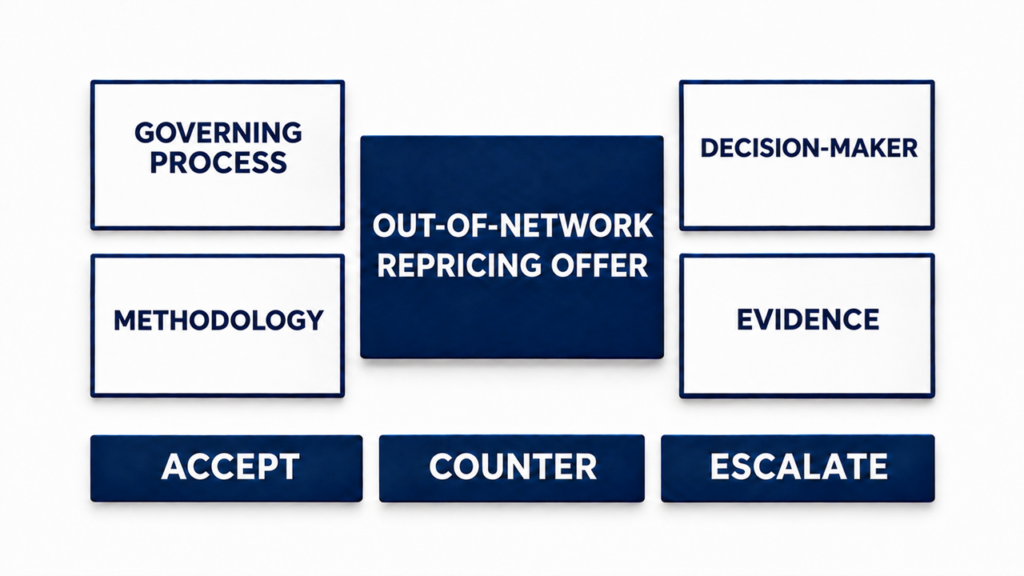
Before responding to an out-of-network repricing offer, practices should identify the governing process, decision-maker, methodology, deadlines, and financial evidence. A disciplined response supports informed acceptance, counteroffers, escalation, and pattern tracking.
Out-of-network repricing companies can influence what a physician practice ultimately receives for services provided outside a payer’s contracted network. They may recommend a payment amount, communicate an offer, or support a payer’s claim-resolution process. Their role, authority, and methodology are not always the same.
That is why the first question should not be, ‘How do we demand more?’ It should be, ‘What governs this claim, who has authority to resolve it, and what evidence supports our position?’
A disciplined response can help a practice protect deadlines, evaluate the offer, document the financial impact, and negotiate from defensible information rather than frustration.
Identify the Claim and the Decision-Maker
Before discussing an amount, determine exactly what is being repriced. The appropriate path may depend on the payer, plan type, service, location, applicable state law, and whether the claim falls within the No Surprises Act.
For certain qualifying out-of-network services, the federal process requires a 30-business-day open-negotiation period before either party may initiate federal independent dispute resolution. Other claims may be governed by state law, a different appeals process, or ordinary payer procedures.
The practice should confirm:
- The payer, health plan, and member product involved
- The claim number, date of service, CPT® code, billed charge, and payment received
- Whether federal or state dispute-resolution rules apply
- The deadline for negotiation, appeal, or escalation
- Whether the repricing company recommends an amount or can approve a settlement
- The person or department with final decision-making authority
A persuasive argument sent to the wrong party or after the applicable deadline may accomplish very little.
Know the Numbers Before You Respond
A practice should evaluate the offer before accepting, rejecting, or countering it. Relevant information may include historical out-of-network payments, current charges, Medicare allowables, internal commercial reimbursement analysis, cost and resource requirements, regional benchmarks, and appropriately filtered Transparency in Coverage data.
Benchmarking requires context. Network, geography, billing entity, rate type, place of service, and effective date can materially change the comparison. Practices should also avoid disclosing payer-specific contractual information that may be confidential.
Instead of saying, ‘The offer is too low,’ the practice can explain the measured variance:
“The proposed amount falls materially below the reimbursement benchmarks we reviewed for this service. We request reconsideration based on the claim-specific information and supporting market data provided.”
Request the Methodology
A practice cannot properly evaluate a repricing offer without understanding how it was developed. Ask what benchmark, geographic area, service code, modifier, percentile, rate source, or payment methodology was used. If the offer was based on a downcoded service or different modifier, request that information as well.
“Before we respond to the proposed amount, please provide the methodology and claim-specific information used to develop the payment recommendation, including any benchmark, geographic adjustment, code, or modifier applied.”
The response may reveal that the parties are comparing different services, locations, or payment assumptions. Correcting that mismatch can be more productive than debating the amount in isolation.
Present the Practice’s Position
The strongest response connects the financial request to the actual service and the practice’s role in delivering it. Depending on the claim, relevant considerations may include specialty expertise, patient acuity, service complexity, geographic access, after-hours availability, avoidance of a higher-cost setting, and documented resource requirements.
“Our practice provided medically necessary specialty care that required the clinical resources described in the attached documentation. We are requesting a payment amount that reflects the service provided, applicable market information, and the circumstances of this claim.”
The objective is not to make every argument available. It is to present the few facts that are most relevant, supportable, and likely to influence the decision.
Do Not Accept Before Validating
An initial offer should not be rejected automatically, but it should not be accepted without review. Compare it with the applicable methodology, available benchmarks, prior payments, and the practice’s documented expectations.
Avoid revealing the practice’s minimum acceptable amount too early. A more disciplined response preserves room for analysis and a supported counteroffer:
“We are reviewing the proposal against the applicable payment requirements and our reimbursement analysis. We will respond with a claim-specific position supported by the relevant data.”
Escalate With Purpose
Front-line representatives may have limited authority. When the variance is material or the methodology remains unclear, request escalation to the person authorized to reconsider the amount. Keep the request professional and specific.
“Thank you for your assistance. Because a material variance remains between the proposed amount and the supporting claim information, please escalate this matter to the appropriate decision-maker and confirm the next review step and applicable deadline.”
Escalation should be tied to a clear objective: obtaining the methodology, correcting an error, reaching an agreed amount, preserving appeal rights, or moving the claim into the appropriate dispute-resolution process.
Track the Claim and the Pattern
Each negotiation should create usable information for the next one. Maintain the claim number, payer, plan type, repricing company, contacts, dates, deadlines, payment methodology, offers, counteroffers, supporting documents, and final outcome.
One low payment may be a claim-level issue. Repeated reductions involving the same payer, repricing company, CPT® codes, or methodology may indicate a broader pattern. Quantifying the frequency and financial impact helps the practice decide whether the issue requires operational correction, payer escalation, legal review, or a larger contracting strategy.
Your Next Step
Select a recent out-of-network repricing offer and reconstruct the complete path. Identify the governing process, responsible decision-maker, deadline, methodology, supporting data, correspondence, and final payment.
Then determine whether the practice handled an isolated claim or uncovered a recurring reimbursement pattern that deserves a broader response.
Building Stronger Payer Strategies
At CodeToolz, we help physicians and healthcare organizations manage payer information, analyze reimbursement, identify payment patterns, and prepare data-supported strategies for payer engagement and negotiation.
Manage. Analyze. Negotiate.
Dana R. Bellefountaine Jr. | Founder & CEO | CodeToolz | The Physician’s Advocate in Payer Contracting
#CodeToolz #OutOfNetwork #PayerNegotiation #PaymentIntegrity #PhysicianReimbursement #RevenueIntegrity #PayerContracting #PhysicianPractices