CMS Just Sent Physicians Another Message: Your Commercial Payer Strategy Matters More Than Ever
The 2027 Medicare Physician Fee Schedule reinforces a difficult reality: practices cannot wait for public payment policy to solve financial pressure. Commercial contracts require active management, practice-specific analysis, and evidence-based negotiation.
CMS finalized the Calendar Year 2027 Medicare Physician Fee Schedule with payment policies effective January 1, 2027. Among the most visible changes are two conversion factors: $32.95 for qualifying alternative payment model participants and $32.63 for other clinicians. Compared with 2026, CMS projects decreases of 1.83% and 2.31%, respectively.
Those numbers matter. But the final rule also delivers a broader message to physician practices: long-term financial performance cannot depend on waiting for Medicare payment policy to improve.
Physicians have limited control over the Medicare fee schedule. They have considerably more opportunity to understand, evaluate, and strengthen the commercial payer contracts that often represent a substantial portion of practice revenue.
The Medicare Change Does Not Automatically Change Every Commercial Contract
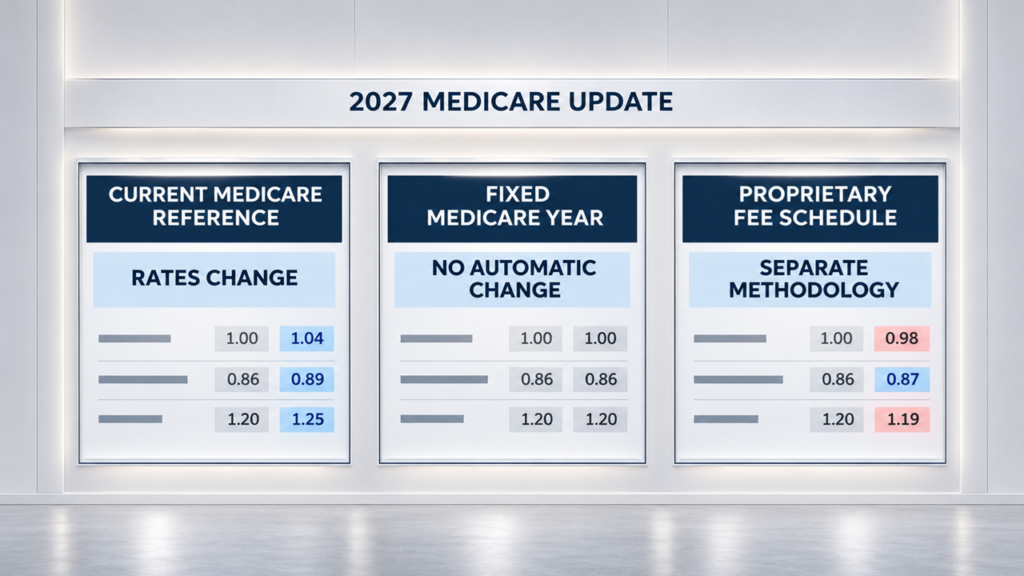
A Medicare payment update does not have the same effect on every commercial agreement. The outcome depends on the reimbursement methodology written into the contract and its related exhibits.
One agreement may pay a percentage of the current Medicare Physician Fee Schedule. Another may reference a specific Medicare year that never updates automatically. A third may use a proprietary fee schedule with no direct Medicare relationship. Geographic adjustments, conversion factors, site-of-service rules, code-specific exceptions, and payer amendments may further change the result.
That means a national Medicare decrease cannot be translated directly into a practice-wide commercial impact. The practice must identify how each payer agreement is structured, determine which reference values apply, and calculate the effect using its own utilization.
Manage: Know What Governs Payment
The first step is knowing what the practice actually has. That includes more than the base provider agreement. Payment may also be governed by amendments, reimbursement exhibits, fee schedules, provider manuals, policy notices, and documents incorporated by reference.
For each commercial payer, the practice should be able to identify:
- The current executed agreement and all applicable amendments
- The fee schedule or reimbursement methodology in effect
- Whether Medicare is referenced and, if so, which year or version applies
- The percentage of Medicare, conversion factor, geographic adjustment, or other calculation used
- The effective date and process for future payment changes
- The contract anniversary, renewal, amendment, and termination provisions
Without that information, a practice may know that Medicare changed without knowing whether any commercial rate moved with it.
Analyze: Measure the Practice Specific Effect
Contract language explains how a payer intends to calculate reimbursement. Analysis shows what that calculation means financially for the practice.
The effect should be measured at the code level and weighted by actual utilization. A simple percentage comparison can be misleading when the practice performs some services frequently and others rarely. The most important question is not whether individual rates increased or decreased. It is how the payer’s current methodology affects the practice’s expected revenue across the services it actually provides.
A disciplined analysis can answer practical questions:
- Which commercial payer produces the strongest overall reimbursement?
- Which agreements are tied to Medicare and will change with the 2027 schedule?
- Which contracts remain anchored to an older Medicare year or static fee schedule?
- Where do high-volume services fall below the practice’s financial requirements?
- Which payer relationships present the greatest opportunity for improvement?
Those findings replace assumptions with measurable financial evidence.
Negotiate: Use the Medicare Update as a Trigger, Not the Entire Argument
A Medicare decrease may explain why the practice is reviewing its payer portfolio, but it should not be the only basis for a commercial negotiation. Payers are more likely to respond to a request supported by the contract, current reimbursement, utilization, market conditions, access, service mix, and the practice’s value to the network.
The goal is not simply to tell a commercial payer that Medicare payment is under pressure. It is to demonstrate how the payer’s existing rates and methodology affect the practice, identify where the agreement no longer supports the relationship, and propose a specific financial or contractual solution.
That solution may include an updated fee schedule, a revised percentage of Medicare, a more current reference year, code-specific increases, protection against unilateral reductions, or clearer notice before reimbursement changes take effect.
The Cost of Standing Still
Commercial contracts can remain unchanged for years while labor, technology, compliance, and other operating costs continue to rise. Some agreements also accumulate amendments and payment policies that make their financial effect increasingly difficult to understand.
The consequences usually appear gradually: declining reimbursement relative to cost, shrinking margins, reduced ability to invest in staff and technology, and greater exposure whenever Medicare payment changes. By the time the financial pressure becomes obvious, the practice may have spent years accepting rates that were never analyzed or challenged.
Standing still is therefore not a neutral decision. It allows every payer update, amendment, and outdated fee schedule to shape the practice’s financial performance without a deliberate strategy.
Where CodeToolz Fits
This is where the CodeToolz process brings the pieces together. The Payer Contract Center gives agreements, amendments, fee schedules, reimbursement terms, and important dates a permanent home. The Contract Analyzer measures how each payer reimburses the services the practice actually provides and shows where meaningful differences exist.
Those findings can then support a focused Negotiation Package grounded in contract language and practice-specific financial evidence. Instead of reacting to one Medicare headline, the practice can manage what it has, analyze what it means, and negotiate what needs to improve.
Your Next Step
Select the practice’s three largest commercial payers. For each one, identify the current payment methodology and determine whether reimbursement is tied to Medicare, a payer-controlled fee schedule, or another calculation.
If Medicare is referenced, document the applicable year, percentage, geographic adjustment, conversion factor, effective date, and amendment process. Then compare the current allowable amounts for the practice’s highest-volume services and weight the results by utilization.
The objective is not merely to determine whether the 2027 Medicare change affects the contract. It is to identify which commercial payer relationship deserves attention first.
Building Stronger Payer Strategies
At CodeToolz, we believe every payer contract tells a financial story. Medicare policy is one part of that story, but it does not define the entire strategy.
Physician practices strengthen their position when they organize the governing documents, measure reimbursement using their own service mix, and enter payer discussions with a specific, supportable request. CMS will continue to change payment policy. Commercial payers will continue to revise their own methodologies. The practice’s advantage comes from understanding those changes before they quietly become part of its financial future.
Dana R. Bellefountaine Jr. | Founder & CEO | CodeToolz | The Physician’s Advocate in Payer Contracting
#CodeToolz #CMS #Medicare #PhysicianFeeSchedule #CommercialPayers #PayerStrategy #PayerContracts #ContractAnalysis #ContractNegotiation #PhysicianReimbursement #PrivatePractice