Managing Payer Contracts Shouldn’t Depend on One Person’s Memory
When payer-contract knowledge exists only in one employee's memory, staff turnover becomes a financial risk. Practices need shared records, documented ownership, version control, critical dates, and a repeatable transition process.

“I just took over for someone who is no longer with the practice.”
A practice administrator leaves. Someone retires. Responsibilities shift. A new employee inherits payer contracting, and years of knowledge suddenly have to be reconstructed.
Where are the current agreements? Which fee schedules are in effect? Were amendments received? When was the last negotiation? Who is the payer representative? What remains unresolved? When is the next contract anniversary?
The person who previously managed those relationships may have known every answer. The problem is not that one person knew so much. The problem is when the practice does not know it too.
Institutional Knowledge Is Valuable
Experienced practice administrators often develop extraordinary knowledge about payer relationships. They understand which contacts are responsive, where unusual provisions are located, what notice period applies, which requests are still pending, and how prior discussions ended.
That knowledge should be recognized and preserved. The objective is not to make an experienced employee less important. It is to ensure that the work they have performed remains useful to the practice and to the people who eventually continue it.
When essential information exists primarily in one person’s memory, inbox, desktop folders, spreadsheet, or personal filing system, the practice becomes dependent on the person rather than supported by a process.
Having the Documents Is Not the Same as Having Continuity
Many practices technically possess their payer contracts. The documents may be on a shared drive, attached to old emails, or stored beside several versions of amendments and fee schedules.
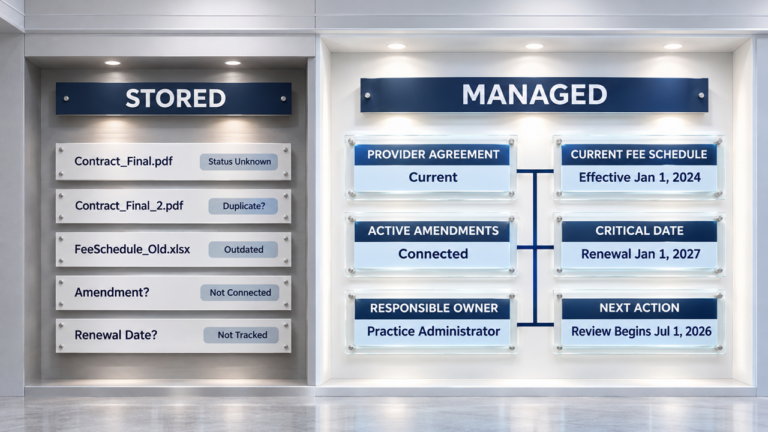
Finding a document does not establish that it is current, complete, or connected to the correct product and effective date. Continuity requires an organized payer record that may include:
- Current agreements, amendments, exhibits, and fee schedules
- Effective dates, anniversary dates, renewal terms, and notice requirements
- Payer products, networks, providers, and locations governed by the agreement
- Payer contacts, representative changes, and escalation information
- Important correspondence, open requests, and follow-up commitments
- Prior negotiation activity, payer responses, and implemented changes
Together, those records explain the history and current status of the relationship. A folder containing contracts alone may not.
Ownership Needs a Backup
Every major payer relationship should have a clearly assigned owner. That responsibility may sit with a practice administrator, contracting professional, revenue-cycle leader, physician executive, or another qualified team member.
Ownership should not mean exclusive knowledge. At least one authorized backup should know where the governing documents are maintained, how to identify the current versions, what deadlines are approaching, and what issues remain open.
Controlled access matters. Contracts and payer correspondence should be available to the people who need them without being broadly exposed. The goal is appropriate continuity, not unrestricted access.
Version Control Protects the Next Decision
A successor should not have to compare several unlabeled documents to determine which amendment governs or whether a newer fee schedule replaced an older one. Consistent naming, effective dates, status notes, and links among related documents help establish the authoritative record.
Version control also protects analysis. A reimbursement comparison built from an obsolete schedule may produce a confident but incorrect conclusion. A negotiation prepared from an incomplete agreement may overlook notice requirements or amendment language that affects the strategy.
The Payer Has Institutional Turnover Too
Practice employees are not the only people who change. Provider-relations representatives, network managers, and payer contacts also move into new roles or leave their organizations.
Important commitments should therefore be documented in writing and preserved with the payer record. If the practice depends on one payer representative remembering a prior discussion, the same continuity risk exists on the other side of the relationship.
Documented correspondence allows a new practice employee or payer representative to understand what was requested, what was promised, what was declined, and what should happen next.
Transitions Should Be a Process Not an Emergency
When payer-contract responsibility changes, the transition should deliberately address:
- Current contract and fee-schedule status for each major payer
- Upcoming anniversaries, notice periods, renewals, and termination dates
- Open payment disputes, fee-schedule requests, and negotiation activity
- Authorized access responsibilities for payer portals and shared systems
- Key contacts, recent correspondence, and the next required action
The transition may occur during planned succession, a reassignment, a vacation, or an unexpected departure. A repeatable process reduces the amount of knowledge that must be recreated under pressure.
Manage Before You Analyze
This is another reason sequence matters: Manage. Analyze. Negotiate.
A practice cannot confidently analyze reimbursement if it is unsure which fee schedule applies. It cannot prepare for a negotiation window if the anniversary date and notice requirements are unknown. It cannot build on prior negotiations if the correspondence and payer response disappeared with the person who managed them.
Good analysis depends on reliable information. Reliable information depends on disciplined contract management.
Your Next Step
Choose one major commercial payer and imagine that the person who knows the relationship best is unavailable tomorrow. Could another authorized person locate the governing contract and fee schedule, identify critical dates, review recent correspondence, understand open issues, and determine the next action?
Wherever the answer is no, the practice has identified knowledge that should be preserved, organized, and assigned a backup owner.
Building Stronger Payer Strategies
At CodeToolz, we help physician practices preserve the information surrounding payer agreements, including contracts, fee schedules, amendments, dates, contacts, correspondence, and negotiation history.
Payer-contract continuity is not about replacing institutional knowledge. It is about making that knowledge durable, accessible to authorized team members, and more valuable to the entire practice.
People and responsibilities will change. The practice’s understanding of its payer relationships should not disappear when they do.
Dana R. Bellefountaine Jr. | Founder & CEO | CodeToolz | The Physician’s Advocate in Payer Contracting
#CodeToolz #PayerContracts #ContractManagement #BusinessContinuity #PracticeManagement #HealthcareAdministration #FeeSchedules #PayerStrategy #MedicalPracticeManagement #IndependentPhysicians