Stop Managing Payer Contracts in Pieces
Contracts, fee schedules, claims data, correspondence, and negotiation history lose strategic value when managed separately. A coordinated process connects agreement management, financial analysis, negotiation, and implementation into one complete payer record.
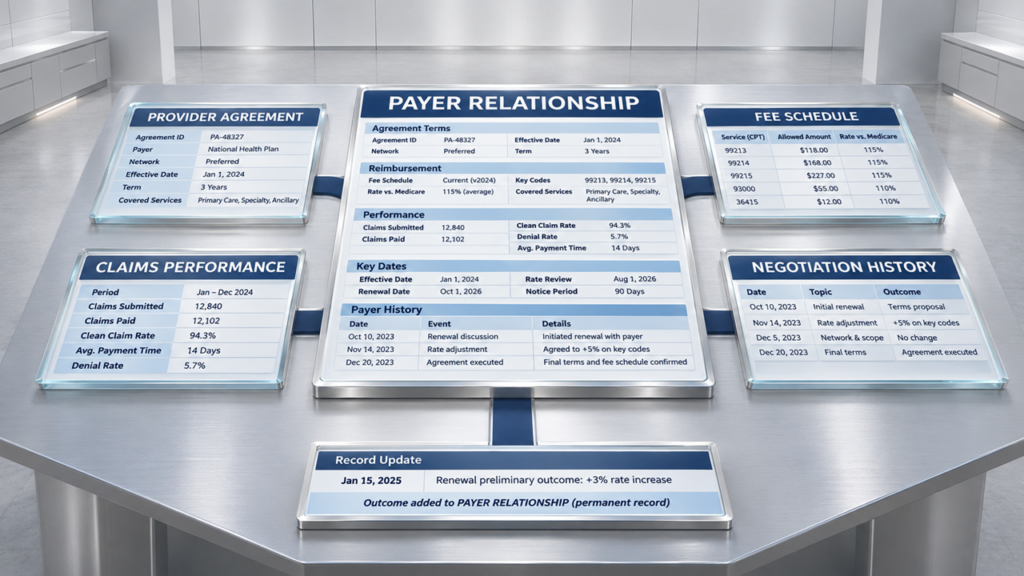
Many physician practices have the pieces of a payer-contract strategy. Contracts are stored somewhere. Fee schedules may be saved in another location. Claims data sits in the billing system. Negotiation correspondence remains in email, and key dates may depend on someone remembering them.
Each piece has value. The problem is that fragmented information does not create a coordinated strategy. A practice cannot confidently evaluate a payer relationship when the agreement, reimbursement data, operational results, and negotiation history are managed separately.
Payer contracting works best as one continuous business process: manage the agreement, analyze its performance, negotiate when change is justified, and return every result to the management system so the next decision begins with a complete record.
Fragmentation Creates Blind Spots
A contract may be available without its amendments. A fee schedule may exist without a clear effective date. The practice may know what a payer allowed on recent claims without knowing whether those amounts match the governing rates. A negotiation request may have been sent without preserving the response or the revised terms.
In that environment, important questions become difficult to answer:
- Which agreement and amendments currently govern the relationship?
- What fee schedule or reimbursement methodology should apply?
- When can the contract be renegotiated, amended, or terminated?
- How does the payer perform across the services the practice actually provides?
- What has the payer previously accepted, declined, or postponed?
The information may exist, but if it cannot be connected, the practice is still making decisions with an incomplete picture.
Manage What Governs the Relationship
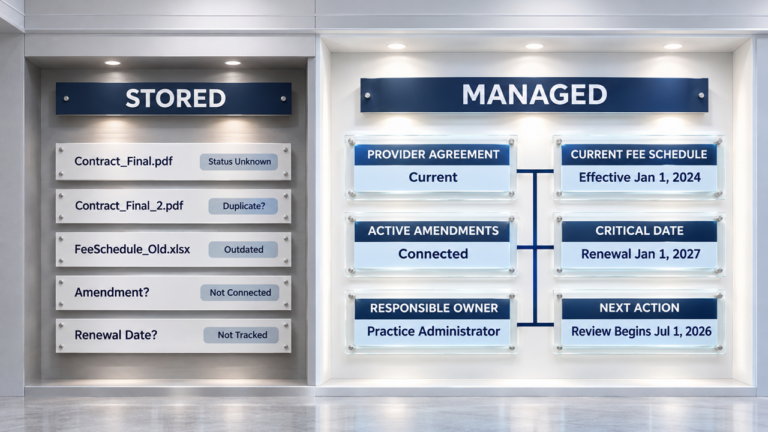
Contract management establishes the foundation. The practice needs the current agreement, amendments, fee schedules, payer notices, products, contacts, critical dates, and material provisions in one organized record.
Management is not simply document storage. It means knowing which documents are current, which terms control reimbursement, what notice requirements apply, and when action may be necessary. It also means preserving payer correspondence and recording the outcome of every negotiation or payment issue.
Without this foundation, analysis can use the wrong rates and negotiations can begin without knowing the agreement’s procedural requirements.
Analyze How the Contract Performs
A contract can be organized and still be poorly understood. Analysis turns documents and payment data into information the practice can use.
That analysis should move beyond a few familiar CPT® codes. It should identify the services that drive utilization, compare contracted reimbursement across payers, evaluate relevant Medicare or market benchmarks, and calculate the financial effect using the practice’s actual service mix.
It should also examine whether the payer is applying the agreement correctly. A rate has little value if it is loaded incorrectly, reduced by an unexpected edit, or applied inconsistently across products, providers, or locations.
The goal is to distinguish among three different conditions: an internal workflow problem, a payer underpayment, and an inadequate contract. Each requires a different response.
Negotiate From a Defined Position
Negotiation should not begin with a generic request for better reimbursement. It should begin with a clear understanding of what the practice has, how the agreement performs, what should change, and what evidence supports the request.
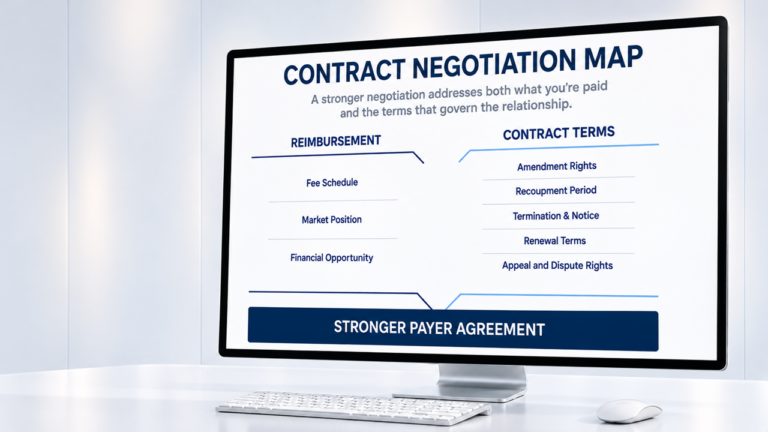
Depending on the findings, the practice may seek revised rates, updated fee-schedule language, clearer modifier treatment, changes to administrative provisions, or correction of payment practices that conflict with the agreement.
Analysis does not guarantee that a payer will negotiate or approve the requested changes. It does ensure that the practice approaches the payer with a defined business issue rather than an unsupported complaint.
The Process Does Not End When the Payer Responds
This is where disconnected workflows often break down. A payer response arrives, but the revised fee schedule is not preserved. A new effective date is not recorded. The practice accepts a proposal without measuring its impact, or a declined request disappears into an email folder until someone starts over years later.
Every outcome should return to contract management. New rates, amendments, effective dates, correspondence, open issues, and follow-up commitments become part of the permanent payer record. The practice can then monitor implementation, verify payment, and prepare for the next decision without rebuilding the history.
Manage. Analyze. Negotiate. Then document the outcome and continue managing the relationship.
One Process With Three Connected Responsibilities
The value is not simply in performing three tasks. It comes from connecting them:
- Management supplies the documents, terms, dates, and history required for analysis.
- Analysis identifies contract performance, payment concerns, risk, and opportunity.
- Negotiation uses that evidence to pursue specific, supportable changes.
- The result returns to management so the record remains current and measurable.
When one responsibility is missing, the others lose effectiveness. Storage without analysis preserves information but does not explain performance. Analysis without management may rely on incomplete documents. Negotiation without either function lacks a reliable foundation.
Your Next Step
Choose one major commercial payer and trace the complete information path. Confirm that the practice can locate the governing agreement and fee schedule, measure performance using actual utilization, identify any payment or contract issue, and document every payer interaction and outcome.
Any break in that path identifies the next process improvement. The objective is not to create more administrative work. It is to stop repeating work because the information was never connected.
Building Stronger Payer Strategies
At CodeToolz, we help physician practices manage payer agreements, analyze reimbursement and contract performance, and prepare focused negotiation strategies supported by their own information and data.
Payer contracts should not be managed in pieces. They should be managed as an ongoing process in which each decision strengthens the record for the next one.
Dana R. Bellefountaine Jr. | Founder & CEO | CodeToolz | The Physician’s Advocate in Payer Contracting
#CodeToolz #PayerContracts #ContractManagement #ContractAnalysis #PayerNegotiation #PhysicianReimbursement #MedicalPracticeManagement #IndependentPhysicians #HealthcareStrategy