The Claim Was Paid. Was the Contract Honored?
A paid claim is not necessarily a correctly paid claim. Practices need an expected-payment method that compares the payer's allowed amount with the governing contract and identifies unsupported variances before they become recurring revenue loss.
Denials receive attention because they are visible. A service was provided, a claim was submitted, and the payer refused payment. The problem can be identified, assigned, and tracked.
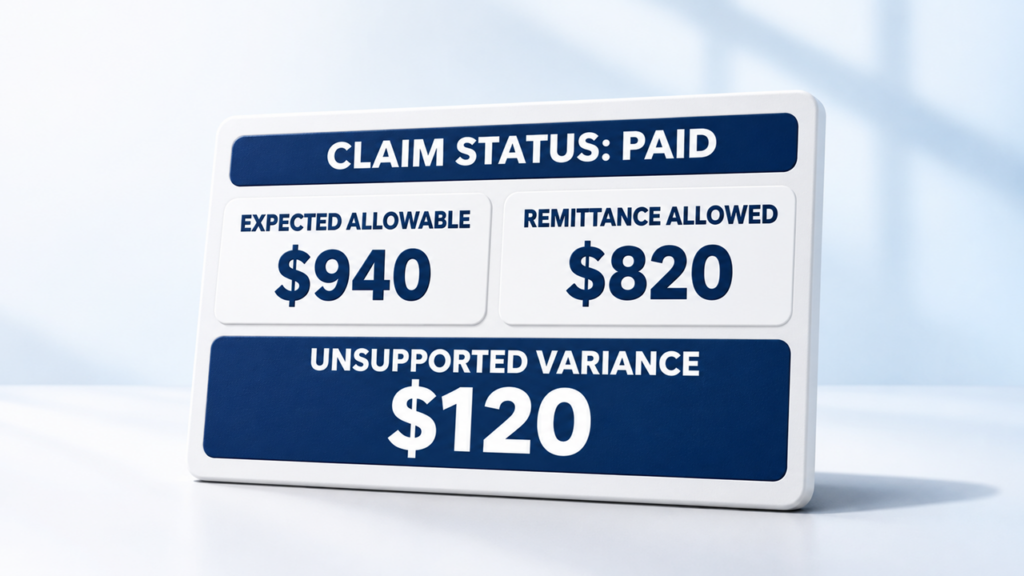
Underpayments are easier to miss. The claim is accepted, an allowed amount appears on the remittance, a payment posts, and the transaction may look complete. But payment alone does not establish that the contract was honored.
A payer can process a claim without applying the correct contracted allowable. When an unsupported variance repeats across high-volume services, relatively small differences can become a significant and persistent loss of revenue.
A paid claim is not necessarily a correctly paid claim.
Why Paid Claims Escape Attention
Most practice-management workflows identify denials, unpaid claims, and outstanding balances. Once money posts, the claim may close without determining whether the allowed amount matches the applicable contract, fee schedule, methodology, and date of service.
That creates a quiet risk. The practice may be receiving payment while still losing revenue through recurring variances that never generate a denial or obvious warning.
Begin With the Contracted Allowable
Payment validation begins by establishing what the payer was contractually expected to allow for the service. That expectation may come from a dollar-based fee schedule, a percentage of Medicare, an RBRVS methodology, a case rate, a bundled arrangement, or another reimbursement provision.
The calculation may also depend on the contract year, product, network, place of service, provider type, modifier, multiple-procedure rule, and incorporated policies. Billed charges matter when the agreement pays the lesser of the allowable or submitted charge.
Before a claim can be labeled underpaid, the practice needs a defensible expected allowed amount supported by the governing documents and the facts of the claim.
The Payer Payment Is Not the Whole Comparison
The payer’s check or electronic payment should not be compared directly with the full contracted allowable without accounting for member responsibility. A payer may establish the correct allowed amount and then assign part of it to the patient through a deductible, coinsurance, or copayment.
A reliable review follows a more precise sequence:
Calculate the expected allowable, compare it with the remittance allowed amount, reconcile payer payment, patient responsibility, coordination of benefits, and adjustments, then investigate any unsupported difference.
This distinction prevents a correct allocation of patient responsibility from being mistaken for a payer underpayment.
What Can Create a Payment Variance
A variance may result from an outdated fee schedule in the payer’s system, application of the wrong contract year, an incorrect reimbursement methodology, a missed escalator, an unsupported modifier reduction, or differences between negotiated terms and claims-processing configuration.
Bundling, multiple-procedure reductions, downcoding, and payment-policy edits require closer analysis. Their presence does not automatically prove an underpayment. The practice must determine whether the adjustment is supported by the contract, incorporated policies, applicable coding rules, and the circumstances of the claim.
The problem may also originate inside the practice. Charges below the contracted allowable may trigger a lesser-of provision. Incorrect coding, modifiers, place of service, or provider information can change reimbursement. Payment integrity requires identifying the source of the variance, not assuming it always belongs to the payer.
Look for Patterns Rather Than Isolated Claims
One incorrectly processed claim deserves correction, but recurring patterns reveal broader financial exposure. The practice should ask whether a high-volume CPT® code is consistently allowed below expectation, whether reimbursement changed after a fee schedule effective date, whether a modifier produces an unexplained reduction, or whether similar claims receive inconsistent allowed amounts.
Patterns help identify whether the issue reflects payer configuration, contract interpretation, billing practices, benefit allocation, or another factor. They also allow the practice to quantify the cumulative effect.
Prioritize the Variances That Matter
Not every difference carries the same financial weight. A small variance on a rarely performed service may have limited impact. The same variance across a high-volume service can create meaningful annual loss.
Prioritization should consider the amount of the variance, service volume, frequency, total financial impact, contractual support, recoverability, payer concentration, and the cost of pursuing correction. Filing, appeal, dispute, and contractual lookback deadlines must also be identified. A valid variance discovered too late may no longer be recoverable.
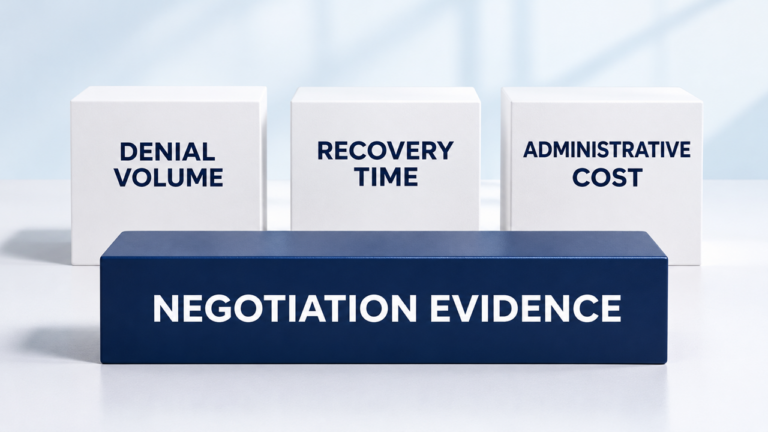
The objective is to identify meaningful, repeatable discrepancies and address them with clear evidence.
Turn the Evidence Into Action
A supported underpayment finding should document the affected claims, expected allowable, remittance allowed amount, payer payment, member responsibility, adjustments, contractual basis, frequency, and cumulative financial effect.
That record can support a focused inquiry, formal appeal or dispute, recovery request, or broader payer discussion. It changes the conversation from “the payment appears too low” to a specific explanation of what the contract requires, how the claims were processed, where the amounts differ, and what correction is requested.
If the payer’s system is configured incorrectly, the remedy should address both retrospective recovery and prospective correction. Recovering past claims without correcting future processing leaves the underlying problem in place.
Payment Validation Should Be Ongoing
A one-time review can uncover valuable information, but payment accuracy is an ongoing responsibility. Contracts, fee schedules, reimbursement policies, coding rules, benefit designs, and claims-processing systems change.
Practices should revalidate high-volume and high-value services after a contract amendment, fee schedule update, material policy change, unexplained reimbursement shift, billing-system transition, or payer platform conversion. Monitoring prevents an unsupported variance from becoming accepted as routine payment.
Where CodeToolz Fits
CodeToolz helps practices connect the documents that define expected reimbursement with the data showing what actually occurred. The Payer Contract Center organizes contracts, fee schedules, amendments, and effective dates. The Contract Analyzer helps establish expected reimbursement and evaluate the financial importance of code-level differences.
Using the practice’s available payment information, we can help identify and quantify recurring variances and prioritize the issues with the greatest financial impact. The practice can then use that evidence to pursue clarification, correction, recovery, or a broader payer strategy. CodeToolz does not replace the practice’s claims follow-up or recovery process. We help establish the contractual and analytical foundation supporting it.
Your Next Step
Select one high-volume commercial payer and a focused sample of frequently billed services. Confirm the current contract and fee schedule, calculate the expected allowable, compare it with the remittance allowed amount, and reconcile payer payment, patient responsibility, and adjustments.
If a consistent variance appears, quantify its frequency and financial effect, identify the contractual basis, and confirm the applicable appeal or dispute deadline before deciding how to proceed.
Building Stronger Payer Strategies
Your payer contract defines what the practice should be allowed. The remittance shows how the claim was processed. Payment integrity requires connecting the two accurately.
The claim may have been paid. The more important question is whether the allowed amount, payment allocation, and adjustments reflect the agreement the practice negotiated.
Dana R. Bellefountaine Jr. | Founder & CEO | CodeToolz | The Physician’s Advocate in Payer Contracting
#CodeToolz #PaymentIntegrity #PayerContracts #Underpayments #PaymentAccuracy #ContractCompliance #PhysicianReimbursement #RevenueCycleManagement #MedicalPracticeManagement #PayerAccountability