Poor Reimbursement Tracking Is Costing Your Practice Negotiation Leverage
Rate differences become meaningful only when connected to actual utilization. CPT®-level tracking helps practices identify which reimbursement gaps create the greatest financial exposure and convert those findings into credible negotiation priorities.
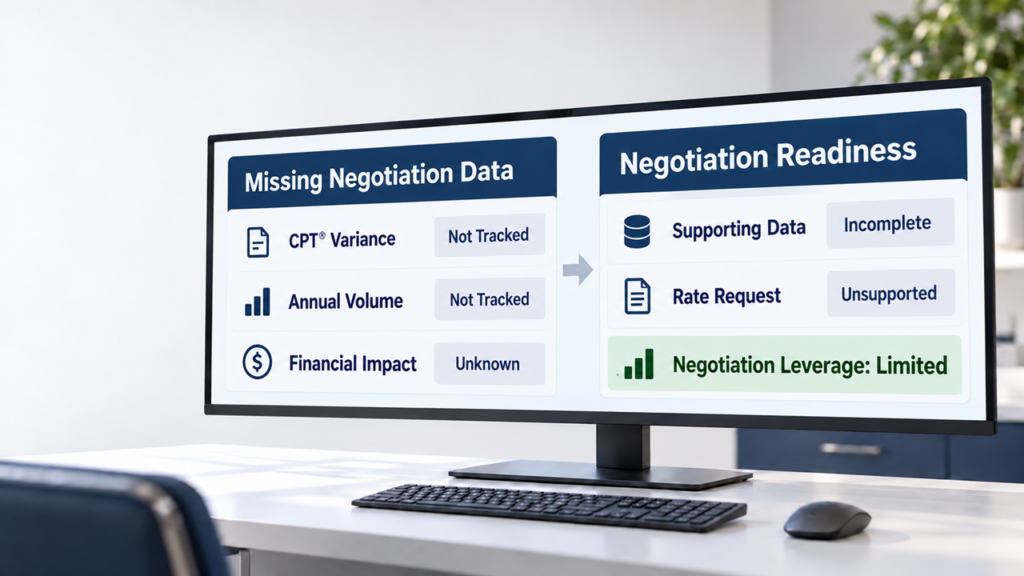
Many physician practices can tell us what a payer reimburses for a familiar service. Far fewer can show, at the CPT® code level, which reimbursement differences matter most across the entire practice. That gap is not merely an analytical weakness. It can cost the practice negotiating leverage.
A payer may be $25 below a relevant benchmark on one service and $15 below it on another. The larger rate gap may appear to deserve immediate attention. But if the first service is performed five times a year and the second is CPT® 99214 performed 3,000 times, the priorities are very different. The second gap represents $45,000 in annual reimbursement exposure.
The basic calculation is straightforward:
Rate variance × actual utilization = projected financial impact
That calculation does not determine what a payer will agree to pay. It does give the practice a disciplined way to decide where analysis and negotiation should begin.
A Rate Difference Is Not Yet a Negotiation Strategy
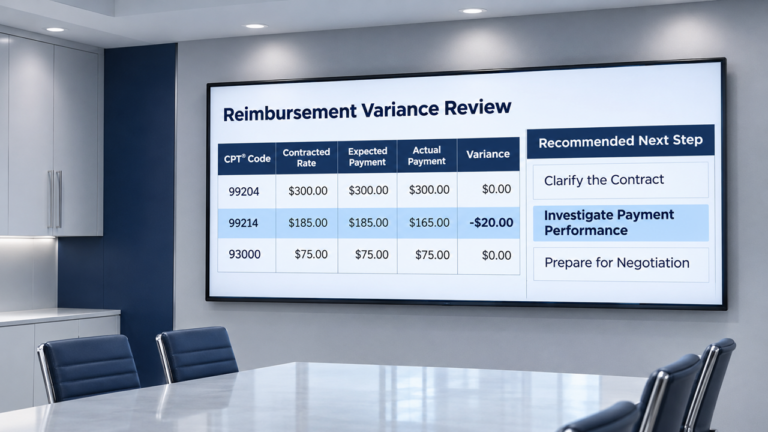
Reimbursement variance can be measured in several ways: the contracted rate compared with the amount paid, one payer compared with another, the current schedule compared with Medicare, the current schedule compared with market data, or the current schedule compared with a payer’s proposed replacement schedule.
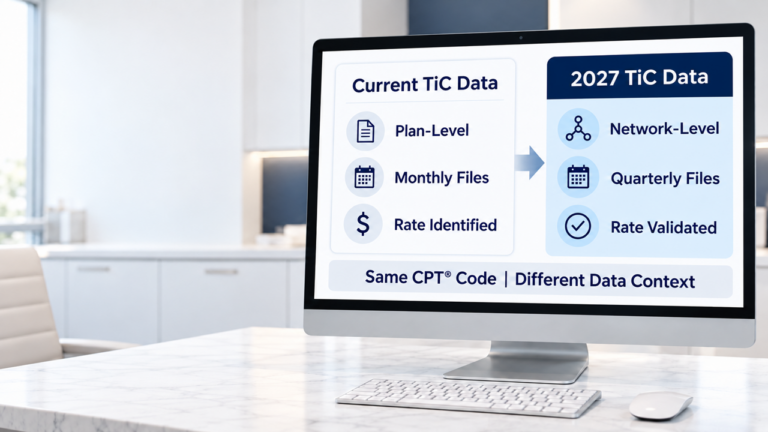
Those comparisons are useful, but they are not interchangeable. Medicare can provide a consistent reference point, yet it is not automatically a commercial-market benchmark. Another commercial payer may use a different product, network, geography, reimbursement methodology, or site-of-service structure. Transparency in Coverage and other market data can add valuable context, but only when the rates are sufficiently comparable.
The strongest analysis identifies both the size of the difference and the reliability of the comparison. A dramatic percentage built on a weak benchmark is less persuasive than a well-supported variance tied to the practice’s actual services and market position.
Financial Impact Is Not Always Recoverable Opportunity
Practices should also distinguish projected financial impact from money that is immediately recoverable. A variance may represent:
- A contractual underpayment that should be researched and, when supported, recovered.
- A weak contracted rate that belongs in the next negotiation request.
- A benchmark gap that supports further analysis but not yet a specific demand.
- A proposed fee schedule change whose effect must be measured before acceptance.
This distinction matters. An underpayment issue follows a payment-integrity workflow. A weak rate follows a contracting and negotiation workflow. Treating every unfavorable difference as the same type of opportunity can lead to the wrong remedy and an overstated negotiating position.
Volume Gives the Variance Financial Meaning
A rate comparison without utilization tells us direction, not importance. Utilization without a comparison tells us activity, not whether reimbursement is competitive. Used together, they reveal where modest differences create meaningful annual consequences.
This is why a practice should not build its request around the codes with the largest percentage gaps alone. High-volume codes with smaller gaps may represent the greater financial exposure. Lower-volume services may still deserve attention when they are strategically important, resource intensive, or essential to patient access, but the reasoning should be explicit.
Payment performance adds another layer. If the payer’s contract rate is acceptable but claims are routinely underpaid, denied, bundled, or delayed, the problem may not be the fee schedule. A concise payment review helps ensure that negotiation priorities are not distorted by operational payment failures.
A Better Way to Prioritize Reimbursement Opportunities
A practical code-level review should consider six factors together:
- Rate variance: How far is the current reimbursement from the selected comparison?
- CPT® utilization: How frequently does the practice perform the service?
- Annualized financial impact: What does the difference represent over a realistic period?
- Benchmark reliability: How comparable and defensible is the reference rate?
- Payment performance: Is the payer honoring the contracted rate consistently?
- Strategic importance: Does the service affect access, staffing, capacity, or the practice’s value to the network?
This approach prevents a negotiation from becoming a broad request for “better rates.” It helps the practice identify a focused group of CPT® codes, quantify the effect, explain the rationale, and support the request with evidence the payer can evaluate.
From Contract Data to Negotiation Evidence
This is where organized contract management and reimbursement analysis must work together. In the CodeToolz workflow, the Payer Contract Center preserves the agreement, fee schedules, amendments, effective dates, and negotiation history. The Contract Analyzer compares reimbursement, applies CPT®-level utilization, and identifies the codes with the greatest financial effect.
The objective is not to produce more reports. It is to turn contract data into decisions. The findings help determine which rates to address, which terms may require clarification, what evidence belongs in the negotiation package, and how the practice will measure the payer’s response.
Data does not guarantee leverage. A payer may still rely on network need, product design, budget constraints, or standardized methodologies. But a practice that knows its high-impact services, documents comparable reimbursement, and explains its value enters the discussion with a stronger and more credible position than one relying on general dissatisfaction.
Your Next Step
Select one major payer and review the practice’s highest-volume CPT® codes. Compare the contracted rates with appropriate reference points, apply actual utilization, and rank the results by annualized financial impact. Then separate potential underpayments from rates that require negotiation. The goal is not to challenge every difference. It is to know which differences deserve action and why.
Building Stronger Payer Strategies
Negotiation leverage begins before the first payer conversation. It begins with organized contract data, reliable comparisons, actual utilization, and a clear understanding of financial impact. When practices manage their contracts, analyze reimbursement, and negotiate from evidence, they are better prepared to protect the revenue that supports patient care.
Dana R. Bellefountaine Jr. | Founder & CEO | CodeToolz | The Physician’s Advocate in Payer Contracting
#CodeToolz #PayerContracting #ContractAnalysis #PhysicianReimbursement #FeeSchedules #ContractNegotiation #PhysicianPractices #HealthcareFinance