The Real Value of Payer Contract Analysis Is Knowing What to Do Next
Contract analysis should do more than display rates. It should reveal missing information, payment concerns, financial opportunities, and payer priorities—giving practice leadership clear evidence for monitoring, investigation, or negotiation.
Most medical practices can see what commercial payers allowed on individual claims. That is not the same as understanding how each payer relationship is performing.
Are contracted rates competitive across the services the practice actually provides? Which reimbursement differences have a meaningful financial effect? Are claims being paid according to the agreement? Which unanswered questions require additional information, and which payer relationships deserve action?
These are management questions, not simply accounting questions. The real value of payer contract analysis is turning contractual and financial information into evidence that helps practice leadership decide what to do next.
Contract Analysis Begins With Knowing What You Have
Before evaluating a payer relationship, the practice needs the documents and information that define it. That includes the executed agreement, applicable fee schedules, active amendments, reimbursement exhibits, product attachments, and the provisions that establish how payment is calculated.
Those materials are not always complete or current. A contract may have been executed years ago. A newer fee schedule may have replaced the version on file. An amendment may have changed reimbursement, notice, or administrative terms. The agreement may reference a Medicare-based or proprietary methodology without supplying the information needed to calculate expected payment.
An analysis built on incomplete information can produce misleading conclusions. Organizing and validating the contractual record is not preliminary clerical work. It is the foundation of reliable analysis.
Numbers Matter but Context Determines Their Meaning
Consider two commercial payers. One reimburses a particular service at 115% of Medicare, while another reimburses it at 135%. The difference is visible, but its importance depends on the practice’s utilization and the rest of each fee schedule.
How frequently is the service performed? Are reimbursement differences concentrated in high-volume CPT® codes? Does the stronger rate on one service offset weaker reimbursement elsewhere? How do both payers perform across the practice’s actual service mix?
Meaningful analysis applies utilization to code-level reimbursement rather than relying on isolated comparisons. It can identify which differences materially affect revenue, where reimbursement deserves closer attention, and how a proposed fee schedule may change the practice’s financial position.
The objective is not simply to find differences. It is to understand which differences matter.
Analysis Should Lead to the Right Decision
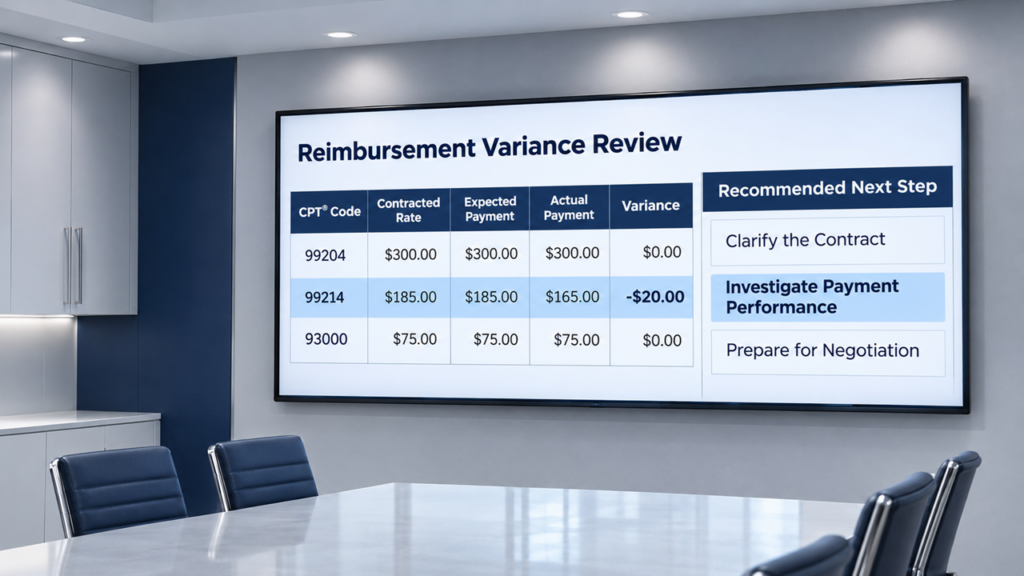
A sound analysis should direct the practice toward an appropriate next step. That step will not always be negotiation.
Complete the Information
The agreement may reference a reimbursement methodology but lack the current fee schedule needed to calculate expected payment. An amendment may be missing, or it may be unclear which products and networks are included. In that situation, the next step is to obtain the missing information before reaching a financial conclusion.
Investigate Payment Integrity
Contracted rates may appear competitive while actual payments do not consistently match expected reimbursement. The appropriate response is to compare paid claims with the governing contract and fee schedule, identify the source of the variance, and determine whether correction, appeal, or broader payment review is warranted.
Continue Monitoring
The evidence may show that reimbursement is competitive, payments are consistent with the agreement, and no immediate contractual issue requires action. Monitoring remains a valid decision when it is intentional, supported, and tied to future fee schedule changes, amendments, payer performance, and contract dates.
Prepare for Negotiation
If the analysis shows that frequently performed services are reimbursed below reasonable comparisons, the practice may have support for a renegotiation strategy. The finding should be translated into priorities, financial opportunity, supporting documentation, and a clear request rather than treated as a general dissatisfaction with rates.
These decisions require different work. The goal is not to negotiate every agreement. It is to make an informed decision about every agreement.
Material Uncertainties Deserve Attention
Contract analysis should identify not only what the evidence confirms but also what cannot yet be established. Missing amendments, incomplete fee schedules, unclear reimbursement provisions, and insufficient utilization data can limit the reliability of a conclusion.
A missing fee schedule does not prove that reimbursement is inadequate. An unfamiliar provision does not establish that a payer is underpaying. Those circumstances identify questions that must be resolved before the practice acts.
A disciplined analysis separates findings from assumptions and unresolved questions. Knowing what cannot yet be established is part of knowing what to do next.
Where CodeToolz Fits
CodeToolz connects three essential disciplines: Manage. Analyze. Negotiate.
The Payer Contract Center centralizes agreements, fee schedules, amendments, effective dates, and contracting activity. The Contract Analyzer compares commercial reimbursement, evaluates rates as percentages of Medicare, applies CPT® utilization, identifies meaningful payer differences, and measures the financial implications of proposed changes.
When the evidence supports pursuing change, we help the practice establish priorities, develop its strategy, and prepare an evidence-based Negotiation Package. The practice retains responsibility for its payer relationships and for signing and submitting contractual communications.
Not every analysis ends in negotiation. It may lead to a document request, payment review, continued monitoring, or negotiation preparation. What matters is that the next step follows the evidence.
Contract Analysis Is an Ongoing Responsibility
Payer relationships change. Fee schedules are updated, amendments are introduced, reimbursement methodologies evolve, and the practice’s service mix changes as physicians join or services expand. Contract analysis should therefore be treated as an ongoing management responsibility, not a one-time project.
Consider a payer proposing an overall increase. The stated percentage may sound attractive, but its financial value depends on how the proposed rates apply to the CPT® codes the practice performs. Applying relevant utilization can reveal whether the offer supports the practice’s objectives or merely appears favorable in the aggregate.
That is the difference between accepting the payer’s description of an offer and understanding what the offer may mean for the practice.
Your Next Step
Select one commercial payer relationship. Confirm that the current agreement, fee schedule, and active amendments are available. Then determine how reimbursement compares across the practice’s high-utilization CPT® codes, whether paid claims align with expected reimbursement, and which material questions remain unresolved.
Finally, identify the supported next action: complete the information, investigate payment integrity, continue monitoring, or prepare for negotiation.
Building Stronger Payer Strategies
Payer contract analysis should do more than describe reimbursement. It should help practice leadership understand the current relationship, identify meaningful opportunities, recognize material uncertainties, and establish priorities for managing the payer.
A well-supported decision may involve further investigation, clarification, monitoring, or negotiation. What matters is that the decision follows the evidence.
Know what you have. Know what you want. Know how to get what you want. Above all, know what to do next.
Dana R. Bellefountaine Jr. | Founder & CEO | CodeToolz | The Physician’s Advocate in Payer Contracting
#CodeToolz #PayerContracting #ContractAnalysis #PayerContractManagement #PhysicianReimbursement #PayerNegotiations #MedicalPracticeManagement #RevenueIntegrity