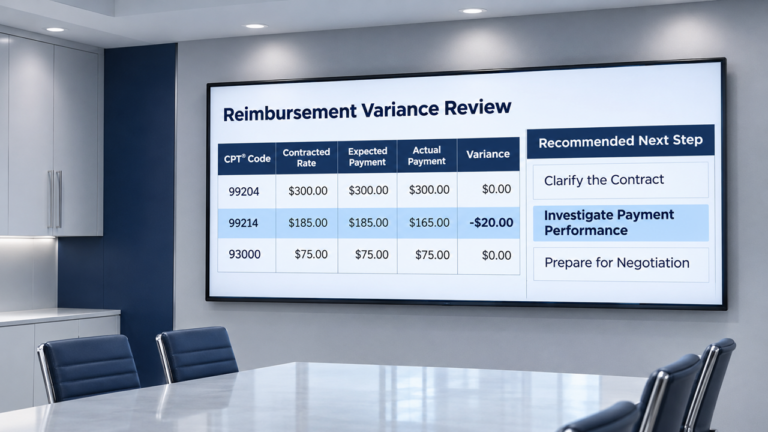
TiC Data Is Changing. Your Benchmarking Method Must Change With It.
Federal changes will reshape Transparency in Coverage files beginning in 2027. Practices must preserve benchmark provenance, understand the transition between reporting methods, and avoid treating differently structured data as directly comparable.
Transparency in Coverage changed what physician practices can know about commercial reimbursement. Negotiated rates that were historically difficult to observe became publicly available through payer machine-readable files.
But access to more rates did not automatically create reliable benchmarks.
The files were enormous. Provider and service combinations could be clinically implausible. Network and product relationships were difficult to interpret. Multiple rates could appear for the same code and provider. A published rate might be technically valid yet economically irrelevant to the physician practice evaluating it.
The federal government has now finalized substantial changes intended to make the files smaller, more standardized, easier to locate, and more accountable. That is important progress. It also creates a transition between two reporting methodologies that should not be treated as interchangeable.
The Transition Begins in 2027
The 2026 Transparency in Coverage final rules were announced on October 5, 2026, published on October 6, and become effective December 7, 2026. The first revised in-network rate and allowed-amount files are due April 1, 2027, followed by quarterly publication on the first day of each calendar quarter.
Until then, plans and issuers are expected to continue publishing under the existing requirements and schema. The transition will continue in stages:
- April 1, 2027: first revised quarterly in-network rate and allowed-amount files
- October 1, 2027: first taxonomy and locator text files
- July 1, 2028: first annual utilization file
Those dates matter because the added context will not arrive all at once. The first network-level files will precede the taxonomy files by six months and the first utilization file by more than a year.
Reporting Will Move to the Network Level
Plans and issuers will generally prepare one in-network rate file for each provider network they maintain or contract with rather than separate files for every plan or policy using that network. This should reduce duplication and file size.
Network-level reporting does not make every rate universally applicable. The analyst must still connect the network to the relevant plan or product, geography, billing entity, contract, and effective period. A rate published within one payer network is not evidence that every physician participating with that payer should receive it.
Unlikely Provider and Service Combinations Will Be Removed
The revised rules require plans and issuers to exclude provider-rate combinations for services the provider would be unlikely to furnish based on internal provider taxonomies or other claims-adjudication rules. This should eliminate substantial noise, such as a specialty appearing with negotiated rates for clinically unrelated procedures.
The improvement introduces a new analytical question: which payer rules determined that a provider-service combination belonged in or outside the file? Beginning October 1, 2027, the taxonomy file should provide greater visibility into those mapping decisions.
Accurate taxonomy and billing information will become even more important. A classification problem could affect whether a relevant provider-service relationship appears in the data used for benchmarking.
Utilization Context Will Arrive Later
The annual utilization file begins July 1, 2028. It will identify providers who submitted and received reimbursement for at least one claim for a covered item or service during the applicable reporting period.
That context can help distinguish an entirely theoretical contracted relationship from one involving at least one paid claim. It still will not reveal the number of claims, the provider’s volume, the practice’s service mix, or whether the published rate is representative of what similar practices commonly receive.
Utilization adds context. It does not establish comparability by itself.
Accountability and Accessibility Will Improve
Plans and issuers will attest that applicable information is true, accurate, and complete to the best of their knowledge and will identify the senior official responsible for overseeing the data. New locator text files and standardized website links should make the machine-readable files easier to find, while a single open format specified through technical guidance should improve consistency.
Those changes may strengthen confidence in the source. They do not prove that every rate selected from the source is appropriate for a particular physician practice, specialty, location, or negotiation.
A New File Structure Creates a New Benchmarking Boundary
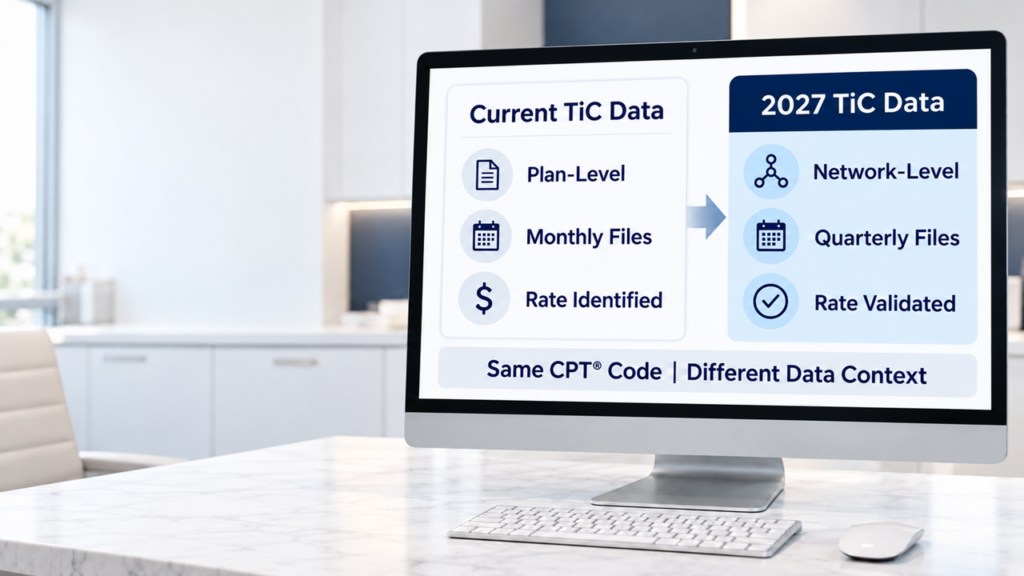
The central issue for practices is not simply that better files are coming. It is that benchmarks produced before and after the transition may represent different reporting units, provider populations, update schedules, and inclusion rules.
A monthly plan-level rate from the original structure should not be blended automatically with a quarterly network-level rate produced under the revised structure. A benchmark created before taxonomy context is available may not be methodologically equivalent to one created after it. Later utilization information may further change how an analyst evaluates the relevance of a published relationship.
The numbers may look comparable while the underlying data is not.
Benchmark Provenance Must Be Preserved
Every TiC benchmark should retain enough information for another qualified reviewer to understand and reproduce it. At minimum, that record should include:
- Source file, publication date, and reporting schema
- Payer, provider network, and related plan or product
- Billing entity, NPI, and provider taxonomy
- CPT® code, modifier, negotiated-rate type, and arrangement
- Geography, place of service, and professional or facility context
- Evidence of utilization when that information becomes available
A benchmark without provenance is difficult to validate and difficult to defend. Preserving the source allows the practice to distinguish a real market signal from a rate that was selected because it happened to be visible.
TiC Data Is One Part of the Analysis
Transparency data can strengthen payer-contract analysis, but it should not stand alone. Current contracted rates, actual allowed amounts, Medicare comparisons, practice utilization, service mix, administrative burden, denial experience, and local network conditions remain essential.
The objective is not to identify the highest rate in a file. It is to determine which rates are sufficiently comparable to help the practice understand its market position and support a reasoned contract decision.
Your Next Step
Review one existing TiC benchmark and ask whether its source can be reconstructed. Can you identify the exact file, publication date, schema, network, product, billing entity, taxonomy, code, rate type, geography, and place of service?
If not, preserve that limitation before the benchmark is used in a payer discussion. Then establish a consistent method for keeping original-schema, revised-schema, taxonomy-supported, and utilization-supported analyses distinguishable during the transition.
Building Stronger Payer Strategies
At CodeToolz, we help physician practices connect payer transparency data to their actual contracts, fee schedules, utilization, and reimbursement performance. That connection is what turns publicly reported rates into useful contract intelligence.
Better-structured data may improve the benchmark, but it does not replace the methodology needed to determine whether a reported rate is truly comparable.
Knowing what a payer reported is only the beginning. Knowing what it means for the practice is what makes the data valuable.
Dana R. Bellefountaine Jr. | Founder & CEO | CodeToolz | The Physician’s Advocate in Payer Contracting
#CodeToolz #TransparencyInCoverage #TiCData #PayerBenchmarking #ContractAnalysis #PayerContracts #PhysicianReimbursement #HealthcareData #FeeSchedules #IndependentPhysicians