Price Transparency Made Payer Rates Knowable. Can You Use Them?
Transparency in Coverage made negotiated rates publicly available, but raw rates are not self-explanatory. Reliable benchmarking requires valid comparisons, normalized data, utilization weighting, and a disciplined method for turning information into contract intelligence.

For decades, commercial reimbursement negotiations operated with a basic information imbalance. Payers could see what they paid across their networks. Physicians and practice administrators generally knew only what appeared in their own contracts and fee schedules.
Transparency in Coverage changed that landscape by requiring most group health plans and health insurance issuers to publish machine-readable files containing negotiated in-network rates. Information that was once largely hidden is now publicly available for examination.
But access to a rate is not the same as access to an answer. A practice still must determine what the rate represents, whether the comparison is valid, and what the difference means financially. Transparency made payer rates knowable. It did not make them self-explanatory.
The Rates Are Public. The Answers Are Not.
Transparency in Coverage files can associate negotiated rates with health plans, networks, billing codes, provider identifiers, billing entities, and reimbursement arrangements. In theory, that creates an unprecedented view of commercial payment information.
In practice, the files are large, technically complex, and filled with records that may not be relevant to a specific physician practice. A single payer may publish multiple rates for the same service because the records involve different products, networks, providers, locations, contract structures, or payment methodologies.
Before using a published rate, the practice must ask:
- Which payer, product, and network does the rate represent?
- Does it apply to a physician, facility, or another billing entity?
- Is the provider or organization meaningfully comparable?
- What geography and place of service are represented?
- Is the rate a fixed amount, a percentage of a fee schedule, or another methodology?
- Does the record apply to the CPT® or HCPCS code and service the practice performs?
- Is the rate current, duplicated, incomplete, or an outlier?
Finding a number is relatively easy. Determining what that number means is the real analytical work.
A Published Rate Is Not Automatically a Benchmark
The highest rate in a file is not automatically the rate every practice should receive. The lowest rate does not, by itself, prove that a contract is unreasonable. Either conclusion can be misleading when the underlying records are not comparable.
A defensible benchmark controls for the factors that materially influence reimbursement. Those factors may include payer product, network, geography, specialty, provider type, place of service, billing entity, code definition, effective period, and reimbursement methodology.
The comparison also should account for the practice’s service mix. A large rate difference on a rarely performed procedure may have little effect on annual revenue. A smaller difference across several high-volume services may represent a much larger financial opportunity.
A benchmark becomes useful when the practice can explain why the comparison was selected, how the data was normalized, and how the variance affects its actual business.
Better Data Still Requires Better Methodology
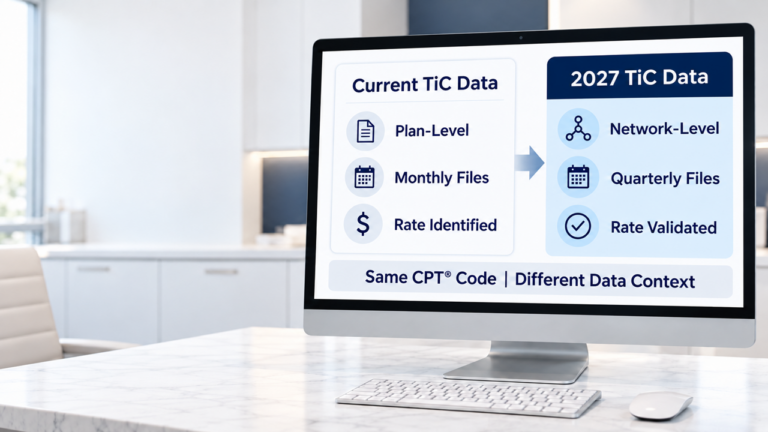
Federal Transparency in Coverage requirements continue to evolve toward greater standardization, accuracy, accessibility, and context. Recent changes are designed to make files easier to locate, reduce unnecessary data burden, increase accountability, and add contextual information such as provider taxonomy and utilization.
Those improvements are important, but they do not eliminate the need for disciplined analysis. More structured data may make records easier to process. It does not decide which providers are comparable, which rates apply to the practice, or whether a difference creates a realistic negotiating opportunity.
Transparency improves the raw material. Methodology determines whether the result is credible.
From Raw Data to Contract Intelligence
Practices do not need to analyze every payer, provider, and billing code in the market. They need to begin with a focused business question and follow a repeatable process.
1. Define the Question
Start with one payer, one network, one specialty, or a defined group of high-volume services. A useful question might be: How do our contracted rates for our 25 highest-volume CPT® codes compare with relevant rates in our geographic market?
A focused question limits noise and helps the practice identify the data needed to support a decision.
2. Confirm the Practice’s Current Position
Before comparing the practice with the market, confirm what the contract actually pays. Locate the executed agreement, applicable fee schedule, amendments, payer notices, and reimbursement methodology. Verify the effective date and determine whether modifiers, site-of-service rules, bundling provisions, or other payment terms affect the listed allowable.
A market comparison is only as reliable as the practice data being compared against it.
3. Normalize the Market Data
Filter the transparency data so the practice is comparing like with like. Confirm the payer product, network, provider type, specialty, geography, place of service, billing entity, and rate methodology. Review duplicate records and outliers rather than automatically treating them as evidence.
The goal is not to find the most attractive number. It is to build a comparison that can withstand scrutiny.
4. Weight the Differences Using Utilization
Apply the rate differences to the practice’s actual service volume. This converts a list of percentages and dollar variances into projected financial impact.
Utilization weighting identifies which CPT® codes create the greatest opportunity, whether the overall effect is material, and how the result may differ by physician, location, or service line. It also prevents low-volume outliers from distorting the negotiation strategy.
5. Build the Evidence Into the Negotiation
Transparency data should support the negotiation, not become the entire negotiation. Payers may also consider patient access, network adequacy, specialty availability, geographic coverage, quality, cost of care, and the practice’s importance to their members.
The strongest position combines comparable market evidence with the value the practice contributes to the network. Instead of saying that other providers appear to receive more, the practice can identify the relevant services, quantify the reimbursement gap, explain the annual impact, and propose a specific adjustment.
Where CodeToolz Fits
At CodeToolz, we connect transparency data to the practice’s actual contracting position. The Payer Contract Center preserves the contracts, fee schedules, amendments, notices, and effective dates that establish the current terms. The Contract Analyzer evaluates code-level reimbursement, applies the practice’s utilization, and shows how relevant benchmark differences translate into financial opportunity.
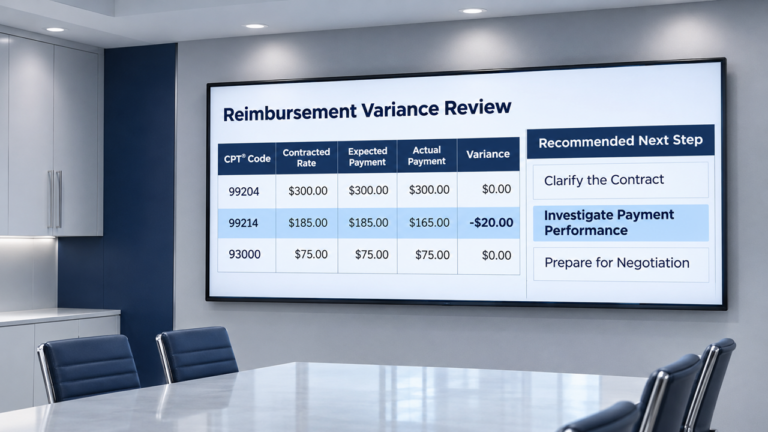
That process helps the practice distinguish an interesting published rate from a defensible comparison. It also connects the analysis to the next decision: accept the current position, investigate a discrepancy, request clarification, or prepare a focused renegotiation.
Your Next Step
Choose one high-volume payer and a manageable group of frequently billed services. Confirm the current contract and fee schedule. Identify relevant transparency records, normalize the comparisons, and apply the rate differences to actual utilization.
Do not ask only whether another rate is higher. Ask whether it is comparable, whether the difference is financially meaningful, and whether the evidence supports a specific contracting request.
Building Stronger Payer Strategies
Price transparency did not make payer contracting simple. It made the market more visible. Practices now have access to information that can help them evaluate reimbursement with greater context, but raw data does not manage a contract, calculate financial impact, or negotiate an improvement.
The advantage belongs to practices that can transform what is publicly knowable into evidence that is practical, measurable, and actionable.
Dana R. Bellefountaine Jr. | Founder & CEO | CodeToolz | The Physician’s Advocate in Payer Contracting
#CodeToolz #TransparencyInCoverage #PriceTransparency #PayerBenchmarking #ContractAnalysis #PayerContracts #PhysicianReimbursement #FeeSchedules #PayerNegotiation #HealthcareFinance