
Putting Payer Negotiations to Work A Client Success Story
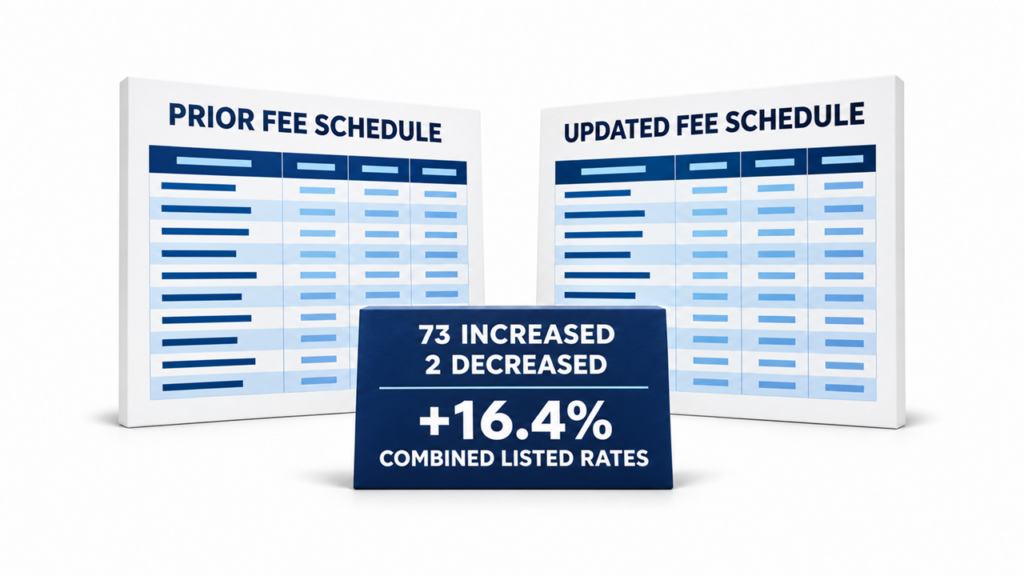
Axon Psychiatry's negotiated fee schedule increased 73 of 75 comparable procedure rates, producing a 16.4% increase in combined listed amounts. The result demonstrates why every payer proposal must be analyzed before acceptance.
Every physician practice wants stronger reimbursement. Achieving it requires more than asking a payer for higher rates. It requires understanding the existing arrangement, identifying a supportable opportunity, preparing the request, and analyzing what the payer ultimately offers.
For Axon Psychiatry, PLLC, that process produced a measurable result. Following negotiations with a major commercial payer, the practice received an updated physician fee schedule effective November 1, 2024. Across 75 procedures with usable rates in both schedules, 73 increased and two decreased. The combined listed reimbursement amounts were 16.4% higher.
The result is meaningful. It also demonstrates why a payer negotiation is not complete until the replacement fee schedule has been analyzed.
A Specialized Practice With a Clear Reimbursement Need
Axon Psychiatry serves patients throughout the Philadelphia region, including individuals with treatment-resistant depression and other complex psychiatric conditions. Its services include Transcranial Magnetic Stimulation, Spravato treatment, and advanced psychopharmacology.
Specialized care requires clinical expertise, trained personnel, treatment resources, dedicated space, and ongoing patient monitoring. Those capabilities create value for patients and the payer’s provider network, but they do not automatically produce adequate reimbursement.
The practice still must understand what its payer agreements provide and determine whether the rates support the services it delivers.
Turning Contract Analysis Into a Negotiation Strategy
Before a practice can develop a credible request, it must understand its current reimbursement position. That means reviewing the applicable agreement and fee schedule, identifying the procedures that matter to the practice, and determining where improvement may be justified.
CodeToolz supported Axon in evaluating its reimbursement arrangement and pursuing improved contractual rates. The objective was not simply to select a percentage and ask the payer to accept it. The request needed to connect reimbursement concerns with the practice’s clinical capabilities, operational requirements, and value to the network.
This is where the CodeToolz disciplines work together:
- Manage the contract, fee schedule, amendments, and critical dates
- Analyze reimbursement to identify differences and supportable opportunities
- Negotiate through a focused request grounded in the practice’s information and value
The result of that work was a new fee schedule. The next responsibility was determining what had actually changed.
The Documented Result
Our comparison of the previous and updated physician fee schedules identified:
- 75 matching procedures with usable reimbursement amounts in both schedules
- 73 procedures with reimbursement increases
- Two procedures with reimbursement decreases
- A 16.4% increase in the combined listed reimbursement amounts across those matching procedures
Several frequently recognized psychiatric and office-based services received double-digit increases. CPT® 90792, psychiatric diagnostic evaluation with medical services, increased by approximately 19.4%. CPT® 90837 increased by approximately 23.9%, and CPT® 99214 increased by approximately 20.6%.
Those code-level changes demonstrate the value of comparing the schedules rather than relying only on the payer’s description of the offer.
What the 16.4 Percent Does and Does Not Mean
The 16.4% figure is a comparison of the combined listed rates for the 75 matching procedures. It is not utilization-weighted, and it does not establish that Axon’s actual revenue increased by 16.4%.
Actual financial impact depends on how frequently the practice performs each service, the number of affected patients, claim volume, payer mix, payment policies, and whether the negotiated rates are applied correctly.
That distinction is visible within the schedule itself. While several psychiatric evaluation, psychotherapy, and office-visit codes received double-digit increases, three commonly used TMS procedures increased by approximately 4.2%. A single overall percentage cannot show which services gained the most or how the changes align with the practice’s service mix.
The appropriate next analysis is to apply historical utilization to the old and new rates. That calculation estimates the expected reimbursement difference based on the services the practice actually performs and reveals where future negotiation opportunities may remain.
Why the Details Matter
A payer may describe an offer as an overall increase, but the practice needs to know what changed at the CPT® code level. Some services may improve substantially, others may move only slightly, and a small number may decline.
A practice that completes this comparison can determine whether the offer supports its financial priorities, identify codes that still require attention, and establish a baseline for monitoring future payments. The new schedule should also be preserved with its effective date so the practice can test actual allowed amounts against the negotiated rates.
A reimbursement increase is an outcome. Understanding, implementing, and monitoring the change is what makes the outcome actionable.
Your Next Step
When a payer issues a revised fee schedule, preserve both the prior and replacement versions. Match the CPT® codes, compare the old and new rates, identify increases and decreases, and calculate both the unweighted schedule change and the utilization-weighted financial impact.
Then monitor claims with dates of service on or after the effective date. Confirm that the negotiated rates are loaded correctly, investigate discrepancies, and retain the analysis as support for payment follow-up and the next negotiation.
The payer’s offer should never be the end of the analysis. It should be the beginning of understanding what the negotiation accomplished for the practice.
Building Stronger Payer Strategies
Axon Psychiatry’s experience shows what can happen when contract analysis and payer negotiation work together. It also reinforces an equally important principle: a strong result must be measured accurately.
At CodeToolz, we help practices manage the documents, analyze the reimbursement, prepare the negotiation strategy, and evaluate the payer’s response. That complete process helps physicians move beyond a headline percentage and understand what the new arrangement means for their practice.
Manage. Analyze. Negotiate. Then verify that the agreement is producing the result the practice worked to achieve.
Dana R. Bellefountaine Jr. | Founder & CEO | CodeToolz | The Physician’s Advocate in Payer Contracting
#CodeToolz #PayerNegotiations #PayerContracting #ContractAnalysis #PhysicianReimbursement #FeeSchedules #Psychiatry #BehavioralHealth #RevenueIntegrity #IndependentPhysicians