Your Billing Company Manages Claims. Who Is Managing Your Revenue?
Billing companies move claims through the revenue cycle, but claims operations do not automatically manage contracts, fee schedules, payment accuracy, payer performance, or negotiation strategy. Practices must assign clear ownership for every revenue-management responsibility.
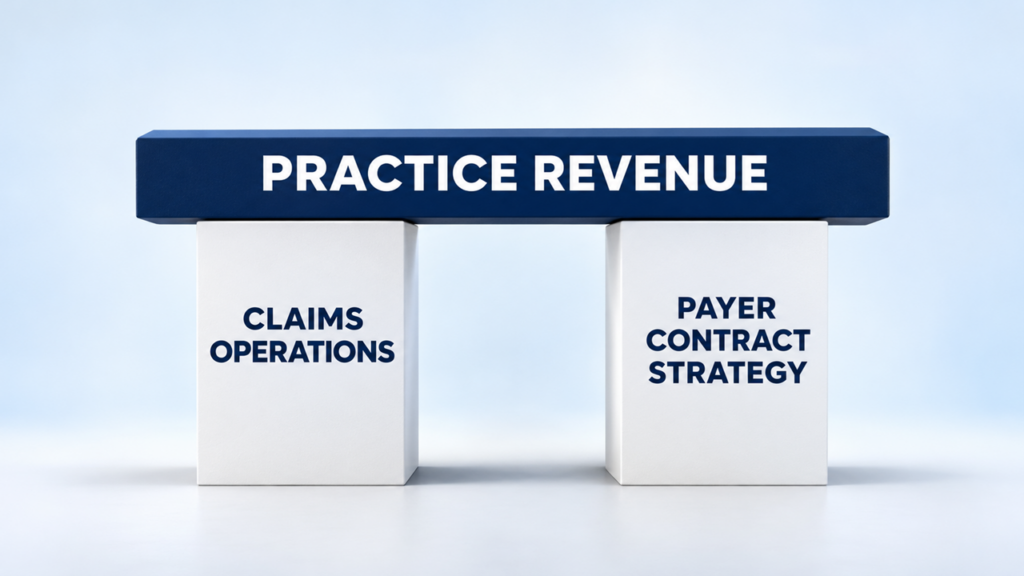
A strong billing company can be an important partner to a physician practice. Submitting claims, correcting rejections, working denials, posting payments, and following up on accounts receivable are essential responsibilities.
Even when those responsibilities are performed well, one important question remains: Who is managing the payer contracts and fee schedules that determine what the practice should be paid in the first place?
Claims operations, Payment Integrity, contract management, and payer negotiation are connected. They are not the same function, and protecting practice revenue requires someone to own each one.
A Correctly Processed Claim Can Still Produce the Wrong Result
Practices often evaluate billing performance through clean-claim rates, denial rates, days in accounts receivable, collections, and payment turnaround. Those measures matter because they show how effectively services are converted into payment under existing payer arrangements.
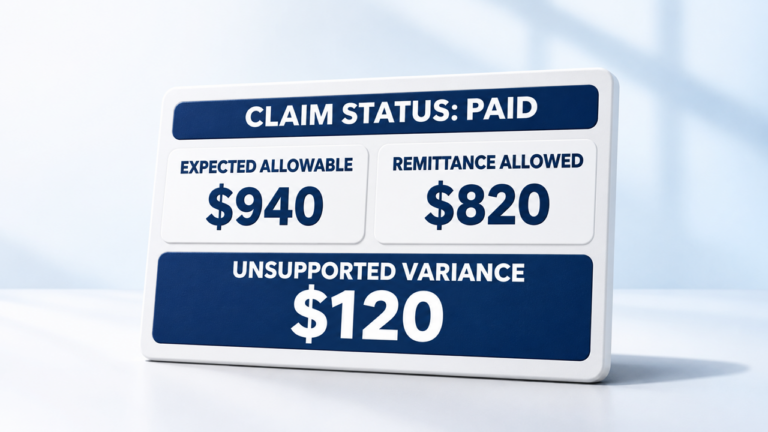
They do not establish whether the payment was accurate or whether the arrangement itself is favorable. A claim may be submitted correctly, processed correctly, and paid exactly according to the payer’s loaded rate while still raising two different concerns.
- Was the claim paid according to the governing contract, fee schedule, modifiers, place-of-service rules, and reimbursement policies?
- Even if the payment was contractually correct, does the underlying rate appropriately compensate the practice?
The first question concerns Payment Integrity. The second concerns contract performance. A practice needs answers to both.
Payment Accuracy Requires an Expected Payment Method
Receiving and posting money does not by itself confirm that the payer honored the agreement. The practice needs an expected payment method built from the applicable contract, fee schedule, amendments, modifiers, place-of-service rules, and payer policies.
Without that configuration, an unpaid claim may be easy to identify while a systematically underpaid claim remains hidden. The claim can appear complete, close automatically, and never be investigated because no one compared the allowed amount with the correct contractual expectation.
Billing companies vary considerably. Some provide sophisticated payment-variance analysis and contract modeling. Others focus primarily on claim submission, follow-up, denial work, and collections. Neither scope is inherently wrong. The practice must know what its billing arrangement includes and who owns every function outside that scope.
A Benchmark Is a Signal, Not a Conclusion
Comparing a contracted rate with Medicare, other commercial payers, market information, or the cost of delivering care can identify a reason for closer review. A rate below one benchmark is not, by itself, proof that reimbursement is inadequate.
The practice should evaluate the code in context, including utilization, payer mix, specialty, geography, place of service, administrative burden, and the full reimbursement methodology. The objective is to determine how the agreement performs across the services the practice actually provides.
Fee Schedules and Contracts Require Active Management
Payer reimbursement may depend on a separate fee schedule, a percentage of Medicare, a proprietary methodology, or several documents and policies working together. Those components can change.
Payers may issue replacement fee schedules, revise reimbursement policies, adopt new claim edits, update a Medicare-year reference, or communicate amendments through electronic notices, provider bulletins, and portal postings.
Someone within or on behalf of the practice must be responsible for:
- Maintaining the current agreement, amendments, policies, and fee schedules
- Preserving prior versions and tracking effective and anniversary dates
- Comparing replacement rates at the CPT® code level
- Measuring financial impact using the practice’s actual utilization
- Confirming that negotiated rates were loaded and applied correctly
- Tracking amendment, appeal, termination, and negotiation deadlines
Submitting claims under an agreement is not the same as managing the agreement. Without clear ownership, payer relationships can operate for years without meaningful financial oversight.
Collections Do Not Measure Contract Performance
Collection performance asks whether the practice received the money available under its current payer arrangements. Contract performance asks whether those arrangements appropriately compensate the practice and support its financial priorities.
A payer that processes claims quickly may still be the practice’s weakest financial performer. Another payer may offer stronger rates but impose substantial administrative costs through denials, prior authorization, documentation requests, or payment delays.
Billing data provides part of the story. Contract and reimbursement analysis provides the rest. Together, they help the practice evaluate rate levels, payment accuracy, utilization-weighted impact, denial and underpayment patterns, administrative burden, and the value of network participation.
Who Is Preparing the Practice to Negotiate?
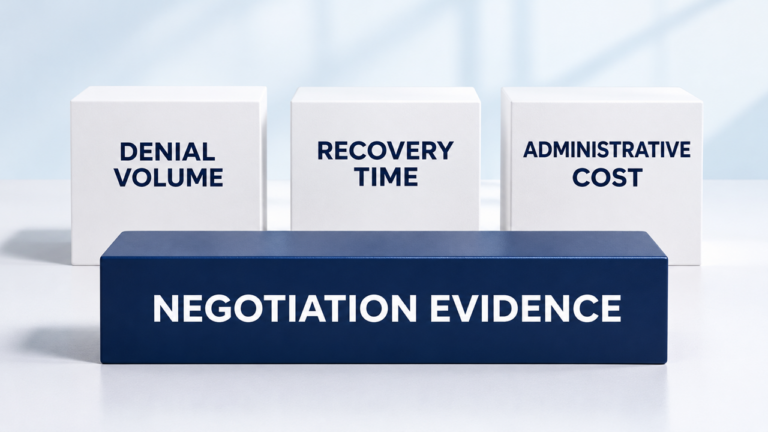
Billing teams may identify recurring denials, underpayments, and difficult payer behavior. That operational knowledge is valuable evidence, but identifying a problem is not the same as building a negotiation strategy.
A prepared practice knows what it has, what it wants, and how it will support the request. That requires the current reimbursement methodology, utilization-weighted financial analysis, relevant benchmarks, payment and denial patterns, the practice’s clinical and market value, the changes being requested, and the applicable negotiation window.
Without that preparation, negotiations often begin with a general request for an increase. A defined problem and measurable request give the payer something specific to evaluate.
Where CodeToolz Fits
CodeToolz does not replace the billing company. We address payer-contracting responsibilities that commonly sit outside the billing company’s scope.
Through the Payer Contract Center and Contract Analyzer, we help physician practices:
- Manage payer contracts, fee schedules, amendments, critical dates, negotiation windows, and reimbursement requirements
- Analyze contracted rates, Medicare percentages, payer performance, utilization-weighted impact, underpayments, and financial opportunities
- Negotiate using organized contract information, measurable reimbursement data, and a clearly defined payer strategy
The billing company helps move claims through the revenue cycle. CodeToolz helps the practice understand and improve the agreements controlling what those claims are worth. The functions should support one another, but neither should be mistaken for the other.
Your Next Step
Review the scope of services provided by your billing company. Identify which Payment Integrity and payer-contracting responsibilities are included, then assign ownership for everything outside that scope.
Who maintains the governing contracts and fee schedules? Who calculates expected payment? Who analyzes payer performance? Who tracks negotiation windows? Who prepares the evidence and strategy when reimbursement needs to change?
If any answer is unclear, the practice has identified a revenue-management gap.
Building Stronger Payer Strategies
Physician practices should expect billing partners to perform the services they were hired to provide. They should also recognize that billing operations alone may not manage the complete financial relationship between the practice and its payers.
Submitting the claim begins the payment process. Managing the agreement, analyzing the reimbursement, and preparing the negotiation determine whether the practice understands and can improve the value of that payment.
At CodeToolz, that is the work we were built to do.
Dana R. Bellefountaine Jr. | Founder & CEO | CodeToolz | The Physician’s Advocate in Payer Contracting
#CodeToolz #PaymentIntegrity #PayerContracts #ContractManagement #ContractAnalysis #PayerNegotiation #RevenueCycle #PhysicianReimbursement #FeeSchedules #PhysicianPractices