Great Operations Can’t Rescue a Poor Payer Contract
Clean claims, strong documentation, controlled denials, and efficient collections protect revenue, but they cannot repair weak rates or unfavorable terms. Practices must evaluate operational performance, payment accuracy, and the contract itself.

A medical practice can submit clean claims, document services thoroughly, obtain authorizations, control denials, and collect efficiently. Those capabilities matter. They protect revenue, improve cash flow, and reduce avoidable administrative loss.
But operational excellence cannot correct an inadequate payer contract. If the underlying rates are weak, the payment methodology is unfavorable, or the payer applies restrictive terms, the practice may execute every internal process correctly and still be underpaid.
That is why reimbursement performance requires more than a well-run revenue cycle. Practices must understand whether claims are processed efficiently, whether the payer is honoring the agreement, and whether the agreement itself remains financially acceptable.
Three Different Questions Determine Reimbursement Performance
When collections disappoint, practices often look first to billing operations. That is reasonable, but it addresses only one part of the problem. A complete review asks three separate questions:
- Was the claim prepared and submitted correctly?
- Did the payer process and pay the claim according to the contract?
- Does the contract provide rates and terms that adequately support the practice?
A billing or workflow problem may reduce collections. A payment-integrity problem may cause the payer to pay less than the contracted amount. A contract-performance problem may mean the payer paid exactly as agreed, but the agreement itself produces inadequate reimbursement. Each problem requires a different response.
Your Payer Contract Establishes the Financial Framework
The payer contract determines more than a list of allowable amounts. It may define the governing fee schedule, reimbursement methodology, lesser-of-billed-charges provisions, multiple-procedure reductions, bundling rules, modifier treatment, timely-filing requirements, amendment rights, and dispute procedures.
Strong operations help the practice perform within that framework. They do not rewrite it.
For example, assume one commercial payer reimburses a group of high-volume services at approximately 85% of the applicable Medicare rates while other contracted payers reimburse those same services at higher levels. Even if every claim is coded correctly and paid without delay, the lower-paying contract can still create a meaningful financial disadvantage.
The percentage is only illustrative. The real impact depends on the practice’s CPT® code mix, utilization, place of service, contractual methodology, and the rates actually applied to claims.
Operational Excellence Protects Revenue Already Available
Accurate coding supports complete reporting of the services performed. Documentation supports medical necessity. Eligibility and authorization processes reduce preventable denials. Payment posting and follow-up help identify missing or delayed revenue.
These functions are indispensable, but they generally protect revenue that the contract already makes available. They cannot manufacture a rate increase, remove an unfavorable clause, or correct a fee schedule that has not kept pace with the practice’s cost and complexity of care.
A practice should continue improving operations while recognizing when an operational solution is being applied to a contractual problem.
A Good Contract Still Has to Be Paid Correctly
Contract analysis and payment integrity must also work together. A negotiated rate has no value if it is loaded incorrectly, reduced by an unanticipated edit, or applied inconsistently across locations, products, or providers.
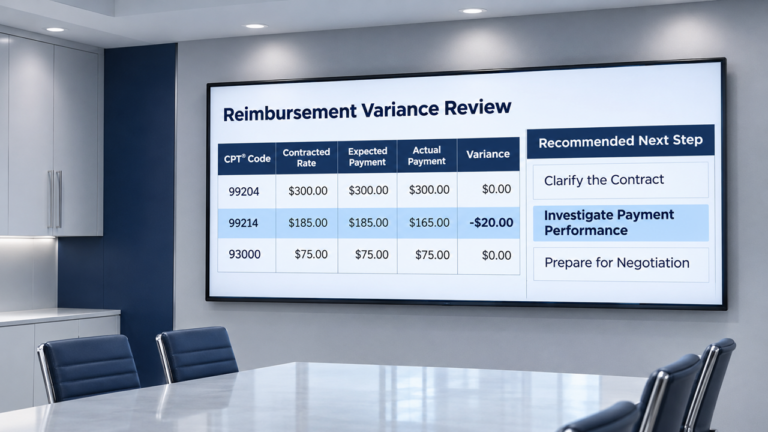
Practices should compare expected reimbursement with actual allowed amounts, investigate recurring variances, and determine whether a shortfall comes from internal workflow, payer adjudication, or the contract itself. This prevents the organization from blaming billing performance for a payer configuration problem or accepting a payment simply because the claim was not denied.
Contract Analysis Turns Concern Into a Measurable Business Issue
A practice cannot evaluate a payer relationship by reviewing a few familiar CPT® codes. It should compare the complete available fee schedule, identify the codes that drive utilization, and calculate the financial effect using the services the practice actually performs.
A utilization-weighted analysis can help answer:
- Which payer produces the lowest reimbursement across the practice’s service mix?
- Which CPT® codes create the greatest financial variance?
- How do contracted rates compare with Medicare, other payers, and relevant market information?
- Where do denials, reductions, recoupments, or administrative requirements further affect performance?
- Which contract presents the most material opportunity for corrective action or negotiation?
The purpose is not to assume that every payer will negotiate. It is to ensure that the practice understands its position before deciding what action is justified.
Operations and Contract Strategy Must Work Together
Revenue-cycle operations and payer-contract strategy are not competing priorities. Operations help the practice capture, submit, and collect revenue correctly. Contract management establishes what should be paid, under which terms, and when the agreement can be changed.
When both functions are managed deliberately, the practice can distinguish a workflow problem from an underpayment and an underpayment from an inadequate contract. That clarity supports better corrective action, stronger negotiation preparation, and more informed payer decisions.
Your Next Step
Select one major commercial payer and review the relationship through all three lenses:
- Operational performance: Are claims clean, timely, and supported?
- Payment integrity: Is the payer applying the contracted rates and terms correctly?
- Contract performance: Do the rates and provisions support the practice’s actual service mix and business needs?
The result will show whether the next step belongs in operations, payment follow-up, contract analysis, or negotiation.
Building Stronger Payer Strategies
At CodeToolz, we help physician practices manage payer agreements, analyze reimbursement and contract performance, and prepare focused negotiation strategies supported by their own data.
Great operations should not be expected to compensate for a contract the practice has never fully evaluated. Manage the agreement. Analyze its performance. Negotiate from a position of knowledge.
Dana R. Bellefountaine Jr. | Founder & CEO | CodeToolz | The Physician’s Advocate in Payer Contracting
#CodeToolz #PayerContracts #ContractAnalysis #PaymentIntegrity #PhysicianReimbursement #RevenueCycle #MedicalPracticeManagement #PayerStrategy #IndependentPhysicians