Putting Contract Analysis to Work
Pine Haven Family Medicine used organized contract information, reimbursement analysis, and a defined negotiation strategy to secure an approximately 15% payer increase—demonstrating how analysis can move a practice from concern to measurable action.

Pine Haven Family Medicine secured an approximately 15% reimbursement increase from a commercial payer. The result matters, but so does the work that made a more informed payer conversation possible.
A practice can know what a payer pays and still struggle to answer a more important question: Is this contract working as well as it should for us?
Pine Haven decided to look more closely. With CodeToolz tools and guidance, the practice turned its contract information into a stronger position for negotiation. Its success offers a useful lesson for physicians and administrators who believe reimbursement should improve but have not known how to move from concern to action.
The Challenge Behind the Numbers
A payer contract is more than a document signed years ago. Its fee schedule affects what the practice receives for the care its physicians provide every day. Yet contracts, amendments, and fee schedules are often stored separately, and the rates that matter most can be difficult to evaluate without a structured process.
That creates a familiar problem. A practice may believe it is underpaid, but belief alone does not identify which payer relationship deserves attention, which services are creating the greatest opportunity, or what request the practice can support with data.
Contract analysis closes that gap. It turns documents and reimbursement rates into information a practice can use to establish priorities and prepare its next payer conversation.
Analysis Must Lead to a Decision
A fee schedule comparison is not valuable merely because it produces percentages. Its value comes from helping the practice decide what to do next.
A disciplined analysis can help a practice understand:
- How current reimbursement compares with relevant Medicare and market benchmarks
- Which high-volume or high-value CPT® codes have the greatest financial importance
- How one payer’s rates compare with the practice’s other contracted arrangements
- What the practice’s utilization means for the overall financial impact
- Which payer relationship presents the clearest opportunity for action
The point is not to create more data for the practice to store. It is to convert the available information into a defensible priority and a focused strategy.
From Information to Action
Pine Haven’s result demonstrates what can happen when contract information is put to work. The practice did not stop at knowing that reimbursement could be better. It used CodeToolz tools and guidance to pursue an improved arrangement with a commercial payer and secured an approximately 15% increase.
Pine Haven’s manager described the experience this way:
“We couldn’t and wouldn’t have been able to accomplish this without the tools you have created and your ability and knowledge to apply them to help us.”
We are grateful for that trust. More importantly, the practice now has a reimbursement improvement it can put to work supporting patient care and practice operations.
What This Result Does and Does Not Mean
An approximately 15% increase is a meaningful outcome, but it should not be interpreted as a guaranteed result for every practice or payer. Each agreement, market, specialty, service mix, and negotiation is different. Some payers may respond with a smaller proposal, a targeted adjustment, or no immediate change.
The repeatable lesson is not the percentage. It is the preparation. Practices negotiate more effectively when they know what they have, understand what the data reveals, and can explain what they want the payer to reconsider.
That preparation also helps a practice evaluate the payer’s response. A proposal described as a percentage increase must still be analyzed at the CPT® code level and weighted using actual utilization. The offer that sounds strongest may not create the greatest financial improvement for the services the practice performs most often.
A Practical Framework for Other Practices
Pine Haven’s story provides a practical starting point for practices reviewing their own payer relationships:
- Manage the current agreement, fee schedule, amendments, and critical dates in one place
- Analyze reimbursement using the practice’s financially important CPT® codes and utilization
- Prioritize the payer relationship with the clearest supportable opportunity
- Prepare a specific request grounded in the practice’s data and value
- Analyze any payer proposal before deciding whether it meaningfully improves reimbursement
The steps are straightforward. The discipline required to complete them consistently is where many practices need support.
Your Next Step
Choose one commercial payer and gather the complete agreement, current fee schedule, amendments, and the practice’s recent utilization. Identify the services that matter most financially and determine whether the reimbursement reflects their importance to the practice.
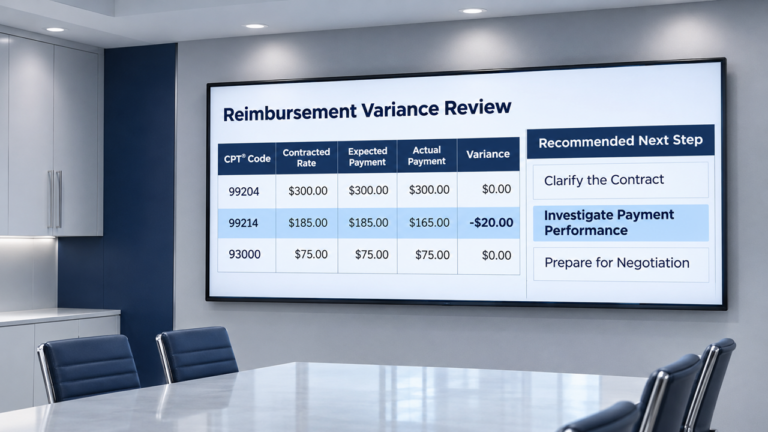
Then ask: What does this analysis tell us to do next? The answer may be to request a missing fee schedule, investigate a contract provision, prioritize a payer for renegotiation, or evaluate whether a proposed increase creates meaningful value.
Contract analysis should produce more than a report. It should give the practice a clearer decision and a stronger basis for action.
Building Stronger Payer Strategies
At CodeToolz, we bring the complete process together. The Payer Contract Center helps practices manage payer agreements, fee schedules, amendments, and critical dates. The Contract Analyzer helps evaluate reimbursement and identify financial priorities. The Negotiation Package converts those findings into a focused, data-supported request the practice can take to the payer.
Pine Haven Family Medicine’s result did not begin with a request for 15%. It began with a willingness to examine the payer relationship and act on what the information revealed. That is what it means to put contract analysis to work.
Dana R. Bellefountaine Jr. | Founder & CEO | CodeToolz | The Physician’s Advocate in Payer Contracting
#CodeToolz #ContractAnalysis #PayerContracting #PhysicianReimbursement #PayerNegotiations #FeeSchedules #PhysicianPractices #FamilyMedicine #PracticeManagement #IndependentPhysicians