Your Payer Contract Is Talking. Are You Listening?
Payer agreements continuously define operational responsibilities, reimbursement rules, deadlines, amendment rights, and financial exposure. Contract analysis connects those provisions to real practice decisions before a denial, recoupment, or dispute forces attention.
Most payer contracts receive little attention until something goes wrong. A claim is denied. A payment does not match expectations. A recoupment letter arrives. An appeal deadline is approaching. Only then does the agreement come off the shelf.
The contract did not suddenly become relevant. It had been defining the relationship all along: what the payer may require, what the practice must do, how reimbursement is determined, when either party may make a change, and what happens when the parties disagree.
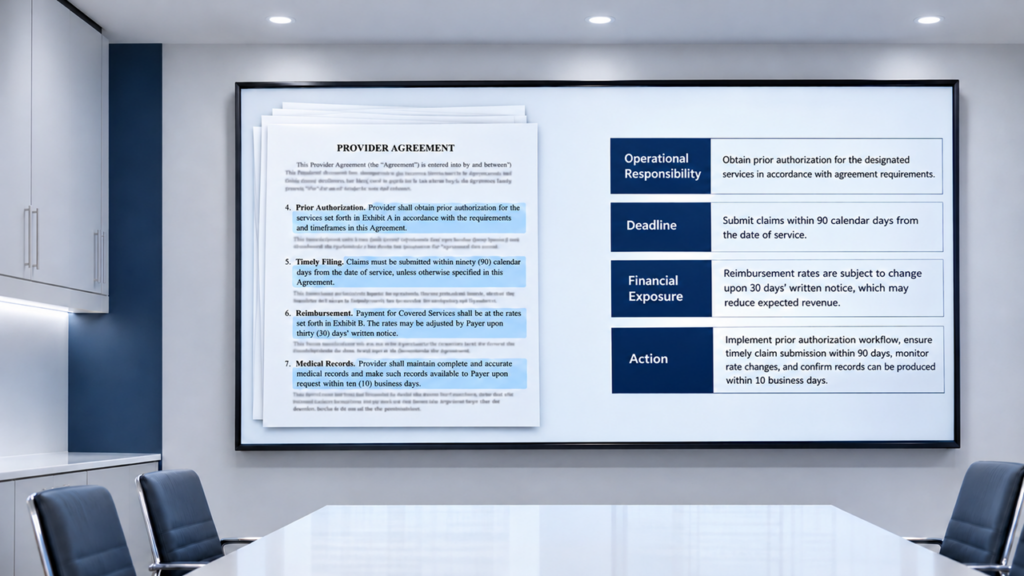
Reading a contract identifies the words. Contract analysis connects those words to operational responsibility, financial exposure, and the decisions a practice may need to make.
Every Contract Communicates
A payer contract is a legal agreement, but it is also an operating framework. Definitions determine scope. Deadlines establish when rights may be preserved or lost. Amendment provisions explain how terms can change. Audit and recoupment language identifies how far back the payer may look and what process may follow.
That is why analysis should not stop with the question, “What does this clause say?” The more useful question is, “What must our practice do because this clause exists?”
Listen for the Operational and Financial Message
Each material provision should be translated into practical questions:
- What does the provision require or permit?
- Who inside the practice is responsible for acting on it?
- What deadline, notice method, or documentation standard applies?
- What revenue, repayment, or administrative exposure could result?
- Can the payer change the requirement without a signed amendment?
- What evidence should the practice preserve if the term is disputed?
This translation is where contract language becomes contract intelligence. A timely filing clause is a revenue deadline that belongs in claims and follow-up workflows. An appeal provision defines the practice’s opportunity to challenge an adverse payment decision.
What Common Provisions May Be Telling You
An evergreen clause may be telling the practice that the agreement will continue unless someone acts within a defined notice window. A unilateral amendment provision may allow the payer to modify certain terms through notice rather than mutual signature. Audit and overpayment language may create exposure long after the original claim was paid.
Payment provisions may reference a fee schedule, percentage of Medicare, a relative-value methodology, the lesser of billed charges or the contracted amount, or another pricing source. The stated rate may then be affected by coding policies, bundling rules, modifiers, multiple-procedure reductions, or site-of-service adjustments.
Termination provisions may establish very different rights for termination with cause and without cause. Network, product, or affiliate language may determine whether the agreement reaches more business than the practice initially expected. The analytical question is not whether the clause sounds standard. It is what the clause can do in this specific payer relationship.
The Signed Agreement May Not Be the Entire Contract
Some agreements incorporate other documents by reference, including provider manuals, reimbursement policies, administrative guides, fee schedules, product attachments, and later amendments. Those materials may contain requirements that directly affect claims, appeals, audits, and payment.
A practice cannot fully analyze the relationship if it reviews only the signature document while the operative details live elsewhere. Contract analysis begins with identifying the complete set of governing documents and confirming which versions apply.
What Is Missing Also Matters
Undefined terms, unclear responsibilities, or incomplete procedures can create ambiguity. That does not mean an omission automatically grants the practice a right or protection. It means the practice should identify the uncertainty, understand how other incorporated terms or applicable requirements may address it, and decide whether clarification or negotiated language is needed.
Ambiguity often becomes expensive only after a denial, audit, recoupment, or disagreement occurs. Recognizing it earlier gives the practice an opportunity to prepare rather than react.
A Practical Contract Analysis Framework
For every material provision, move through five steps:
- Language: What does the agreement actually state?
- Obligation: What must the practice or payer do?
- Operational impact: Which workflow, person, deadline, or document is affected?
- Financial impact: What payment, denial, recoupment, or administrative cost is at risk?
- Action: What should be tracked, tested, clarified, or negotiated?
This framework keeps analysis from becoming an abstract legal reading exercise. It connects the contract to the daily operation and financial performance of the practice.
Analysis Changes the Conversation
Practices that understand their contracts approach payer relationships differently. They can identify a notice window before it closes, test whether paid claims reflect the agreed methodology, recognize when a new policy may conflict with existing terms, and bring specific concerns to the negotiating table.
They can ask focused questions: Which provision permits this change? Which fee schedule is being applied? What appeal route governs this denial? What supports this recoupment? Specific questions are harder to dismiss than general dissatisfaction.
Where CodeToolz Fits
This is why CodeToolz connects management with analysis. The Payer Contract Center helps practices preserve agreements, amendments, fee schedules, effective dates, and negotiation activity. The Contract Analyzer helps evaluate reimbursement terms and fee schedules using the codes and utilization relevant to the practice.
Together, they turn contract language and payment data into information practices can use to manage risk, evaluate performance, and prepare for negotiation.
Your Next Step
Select one material provision from a major commercial payer contract. Timely filing, amendments, appeals, audits, reimbursement, or termination is a good place to begin. Then document five answers:
- What does the provision say?
- What does it require the practice to do?
- Who owns that responsibility?
- What financial consequence could follow?
- What action should be taken now?
If the practice cannot answer all five, the contract is already identifying an opportunity for stronger management and analysis.
Building Stronger Payer Strategies
At CodeToolz, we believe stronger payer strategies begin with understanding, not assumptions. We help physicians and practice leaders manage, analyze, and negotiate their payer relationships with greater clarity and control.
Your payer contract is talking. The advantage begins when the practice learns how to listen and what to do with the message.
Dana R. Bellefountaine Jr. | Founder & CEO | CodeToolz | The Physician’s Advocate in Payer Contracting
#CodeToolz #PayerContracts #ContractAnalysis #ContractManagement #PayerStrategy #PhysicianPractices #PhysicianReimbursement #PaymentIntegrity #ContractNegotiation #MedicalPracticeManagement